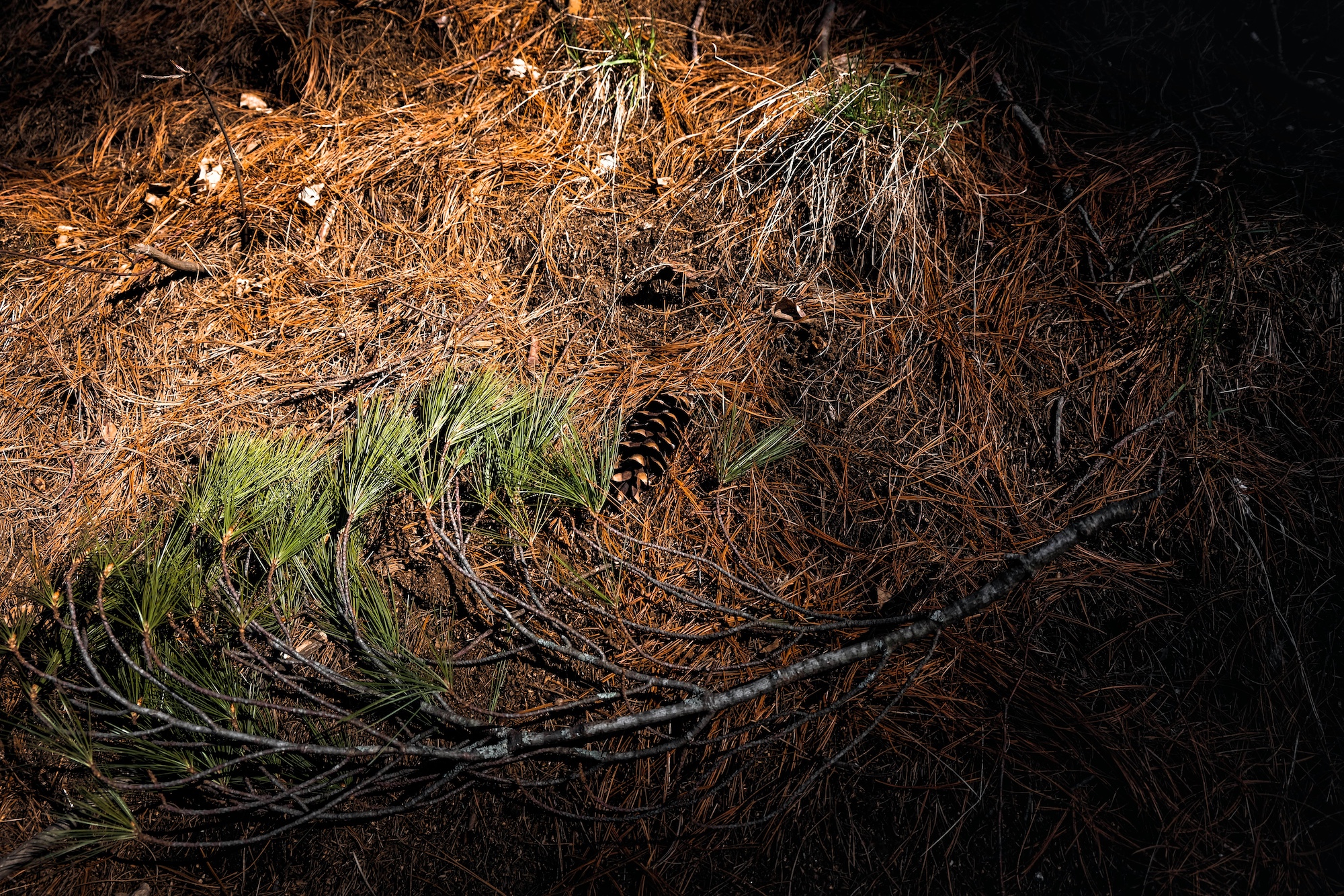
The first weekend of February, and finally a mild and sunny day. I’m walking around my yard picking up branches that have fallen the past few weeks. It’s not something I need to do; I just want to be out there. I crouch down and reach for a branch in the little pine grove where you have to duck to walk around. I glance left and catch my breath. There in peaceful repose, nearly camouflaged by the dead pine needles, is a coyote. Unlike some I’ve seen, this one is not scary-thin or mangy. With its full coat and bushy tail, it looks perfectly healthy. Except for being dead.
Animals in the wild are living on the edge all the time, I know. Anything could kill them, especially in winter. In the little pond, where I just counted seven koi belly-up, I know the cause was the bubbler and heater failing during the spell of below-zero days. But what killed this creature stretched out before me? I take a picture and then finish up hauling branches and go inside.
It’s late afternoon on Saturday, and I don’t expect to reach anyone at the forest preserve. But I send a message to someone I know there, along with the photo. My yard backs to forest preserve land, and this isn’t the first time I’ve contacted them about an injured or dead critter. They will want to know. Then I go for a walk and run into a neighbor doing the same thing I’d been doing: dragging and piling up branches in her yard. I tell her about the dead coyote and show her the picture on my phone. She works in conservation, and I think she’ll be interested. She starts to speculate, mentions poisoning. That hadn’t occurred to me, and I don’t want to think it’s a possibility.
On Monday, I hear back from my forest preserve friend. We chat about the calls they’ve been getting–the crazy things people claim to have seen. He says he always tells them, take a picture. He adds, your photo was great, and tells me they’ll be over in the afternoon.
Later, I look out the porch window and see that they’ve arrived, already poking around in the backyard. I join them, and for a moment I can’t find the spot. I wonder if they are thinking there isn’t going to be a dead coyote here. Then I see it, startled again at how well it’s hidden in plain sight, blending in. I point to the animal, then keep my distance when Justin turns it over. He sees blood at its mouth and says it was most likely struck by a car. But, I think, the injured coyote had made its way here from the road. Had it been here before? Had I seen it alive and alert, trotting across the yard? I take some comfort imagining that it knew and sought this shelter, lying down on the soft pine needles to await whatever would come. Just a few feet away is the burial place for my last two cats. My animal graveyard.
They load the coyote into a brown garbage bag, then double bag it. According to procedure, they tell me. It seems an apology; the creature deserves a more dignified shroud. The three of us go quiet, staying still in a tacit show of respect. Then they make their way back to my driveway and down to their truck, waiting in the street.
Photo by Frederic Bourbeau on Unsplash.
Sherry Stratton
Formerly a technical writer, Sherry Stratton now focuses on subjects close to her heart. Her
short essay “Floater” was published in Great Lakes Review in September. Her work has also
appeared in the anthology Songs of Ourselves: America’s Interior Landscape and in Minerva
Rising, Leaping Clear, Punctuate, Portage, and the Center for Humans & Nature. Recently she
was named a finalist in Frontier Poetry’s Tanka Challenge. Sherry is editor of DuPage Sierran
and was copy editor for Fifth Wednesday Journal for eight years until the magazine’s close. She
lives beside a forest preserve in northeastern Illinois.