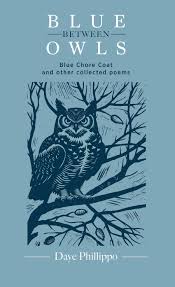
While reading, “Blue Between Owls: Blue Chore Coat and other collected poems” I fell into a serene space of life in the rural Midwest. I was also lulled into a place of nostalgia when standing with the poet throughout the turning of seasons, especially the way winter nestles you into warm farmhouses to wait weather out, a childhood feeling of security. In moving through literary examination of the natural world around her, larger themes of life are made palpable, quietly yet profoundly, throughout this collection.
Published by Codhill Press in 2026, Daye Phillippo’s, “Blue between Owls” is a recommended read. Divided into five sections, the first poem offers an “Owl Prayer.” We arrive at the end of a year, reflection and repose. “I bow my head/ to the page again, cycle of readings/ nearing year’s end, Revelation of St. John.” Referencing the ‘Book of Revelation’ or the ‘Apocalypse of John,’ the final book of the Christian Bible, the religious text presents a series of symbolic visions that John of Patmos receives during exile.
Revelation, from the Greek word apokalypsis, meaning ‘unveiling’ or ‘disclosure,’ “Blue between Owls,” is a subtle disclosure of existential contemplation. Phillippo’s gentle layering of visions, a work of her own revelations from the seclusion of barn and farmland. The reader is brought home to the quiet hours of the Midwest through sections titled, “Blue Chore Coat,” “Migration,” “Between Owls,” “Apertures,” and “Midwest Palimpsest.”
Daye Phillippo taught English at Purdue University and later earned degrees in creative writing from Purdue University (2011) and the Warren Wilson MFA Program for Writers (2014). Her poems have been nominated for a Pushcart Prize and selected by Educational Testing Services for inclusion in the AP English Exam. She is the recipient of a Mortarboard Fellowship, an Elizabeth George Grant for work in progress, and a Tennessee Williams Scholarship for poetry.
Her work has appeared or is forthcoming in Poetry, Valparaiso Poetry Review, The Midwest Quarterly, LETTERS, Shenandoah, Cider Press Review, Twelve Mile Review, One Art, Natural Bridge, Presence, The Windhover, and many others. Her debut poetry collection, Thunderhead, was published by Slant in 2020. Her second collection, Blue Between Owls, with Codhill Press, received the 2024 Codhill Press Pauline Uchmanowicz Poetry Award.
Codhill Press is an independent literary publisher founded in 1998 and based in New York’s Hudson Valley. The press is known for publishing poetry, literary fiction, and creative nonfiction.
I encountered Phillips’s work through the poem, “Aperture and Shutting the Chickens in for the Night,” as featured in her collection published with Great Lakes Review on March 26, 2026. A glimpse of the larger work, “Blue Between Owls” is an integral and honoured voice of the Great Lakes community.
Phillippo raised a large family before pursuing her writing degrees. She now lives with her husband in a creaky old farmhouse in rural Indiana. She gardens and tends Barred Plymouth Rock hens.
More of her work can be found at www.dayephillippo.com.
Phillippo invites us into an atmosphere of the twilight hours, when nocturnal turnings begin resting and the morning wildlife begin waking. In “Requiem,” I crept into the residue of a Great Horned Owl, “revealed only/ by its call, tones so deeply resonant,/ I hear its girth,”… “its bassoon’s tenor register,” made of “aged maple/ and melancholy, as if the day is, too….” In quiet contemplation, Phillippo integrates nature with extension. The language of nature speaks to the corners of her world.
Again, later, when waiting for sleep,
“waiting/ for the allergy pill to kick in so you can sleep/ when you find yourself between the love song/ of two Great Horned Owls, one on one side/ of the house, one on the other, further off,/ and you realize that you are the compass point/ of their are, their eyeshine, their wings in the dark.”
Phillippo exists between, between hours and between nature’s conversations. Blue between, like melancholia. Yet, I found peace here with her.
The fabric of nature in “Blue between Owls” is a landscape moving with life-teachings and life’s reflections. Phillippo eloquently braids the physical with the profound. From the burn piles of “Unburned heap,” Phillippo writes, “When I walk near,/ a smoke of sparrows rises/ from the pile suggesting/ that one thing/ becoming another/ is just the way of things.” The sediment of her poetry folds fluxes of nature into the psychological.
The poet, between owls, plays on the parallels and existing amongst them. “In this old farmhouse,/ early morning dark,/ Great Horned Owls call.” In these hours before day break, she is there, between. From this liminal state, she carries the reader through contemplating the blink of existence. “Between earth and stars/ longitude and latitude,/ convergence between owls.” She grows into something deeper here, wiser and aware.
Like a book of hours, timing is carved out. We are grounded in a slow cycle as the poet visits the barn each morning to begin her daily chores. “In the morning when I slide open/ the heavy old barn doors on its track/ and step inside,” and from a “Tall rectangle of light” life passes through these apertures. “Its hand-hewn rafters/ where barn swallows nest,/ fly in and out/ through gaps made/ by neglect and the passage/ of time, the way the body/ falls into disrepair.” With poems that deal with death and aging, the poet finds answers in the comings and goings of nature. “I wonder if stepping/ from this life/ into the next will be like/ stepping through/ an aperture like this/ and I hope it’s true, ordinary/ mornings like this.” An inverse is established, that the profound can become ordinary, fathomable and as observable as the world around us. Further, that we want this ordinary in the crux of existential unknowing.
Time and place further fixate the poet in a state of consciousness contemplating those who came before her; especially women. “It could be any century and I could be looking up/ where another woman once stood outside….” The poet, in locating herself within the landscape around her, feels out memory. In this grounding, Phillippo masterfully encompasses macro-processes of human experience, colonial and feminist, into four lines.
“If recollecting were forgetting,/ like four deer, I, too might be able to leap over/ the regrettable histories of things and go on loping, beautifully,/ and with ease into the east field.”
We pause with Phillippo and we acknowledge what came before that brought us to where we stand, at kitchen windows, the drift of snow capping, and we watch nature shift around us. Phillippo carries such pain and trepidation of the way of being, yet, she expertly balms this unease into the grace of poetry.
One image that carried me into repose was ‘Missing Parts Poem,’ which resonated to me as a mother and what will become of the future. “I have not walked… to the mailbox/ and back, a small, sticky hand in mine.” Life’s changes, flux and flow, the residue of our lives.
Perhaps the deer do remember and they crest fence and rail knowing. Perhaps owls carry the same conversations as we do, in weight and heart, reciprocal culling within the glow of moon and the shadow of night.
Thank you to Daye Phillippo and Codhill Press for a complimentary copy in request for an honest review.
Sara Hailstone
Sara Hailstone’s writing is born from navigating the raw and confronting connections that living in rurality projects by scouring domestic landscapes. She is an educator and writer from Madoc, Ontario who orients towards the ferocity and serenity of nature and what we can learn as humans from the face of forest in our own lives. A graduate of Guelph University (B.A.) and Queen’s University (M.A. and B.Ed.), she has also finished her Masters in English in Public Texts at Trent University which has set her along a path of passion of literature.
Sara has had poetry, short stories and essays published in various publications. She is now working on her debut novel with Running Wild & RIZE Press. Sara has grown up immersed in the tones of Canlit, her navigation of the Great Lakes brushstroked by writers like Jane Urquhart and her novel The Underpainterof frozen snowdrifts and expanses of water horizons. She has been inspired by conversations around Survivaland the imagination of a Canadian Shield crowning the lakes like a sleeping lizard and terrain that early settlement braced against and ancient societal formations thrived upon. The waterways as a portal to sacred movement, remembered with petroglyph, Sara looks forward to expanding her literary impression of the Great Lakes more south and in textual consciousness unknown.