It never fails to amaze me when I travel 30 minutes north to the Greater Toronto Area (GTA)’s edges and experience the different universes of small towns that are so near, yet so far. In the past few years, I have had to travel to these far-near constellations because the few people I know and love have been priced out of the GTA. Although you can always find familiar marks of civilization in these towns (i.e. a Tim Hortons and a McDonald’s), certain oddities exist more boldly in these towns that jolt city slickers like me.
I’ll give you an example of what I mean. Last year, my friends and I drove to East Gwillimbury for Thanksgiving. After picking our friend up from Brampton, we avoided the 400 and “drove instead along country roads…that go up and down and take you past farm fields, villages, and towns” (Alexis 17). Somewhere along the way, we saw an audaciously perched flag in front of one farmhouse: a blue saltire with white stars over a red field. There was no time to register the shock of the moment. The movie reel of farmhouses running outside the windows quickly replaced the past obscene frame. We kept on driving.
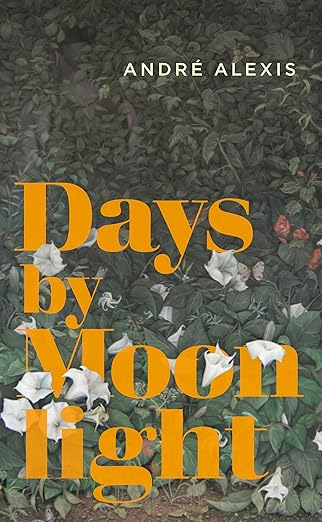
These kinds of weird jolts experienced in Canadian small towns are central to André Alexis’ 2019 novel Days by Moonlight. A travel narrative, the novel features the protagonist Alfred Homer (Alfie), a botanist who accompanies Professor Morgan Bruno on a journey out of downtown Toronto to Barrow from August 20th to the 27th in 2017. The rationale for the trip is the professor’s strange fixation on the fictional poet John Skennen, who has mysteriously disappeared. The professor wants to learn more about the author by travelling to all the small towns associated with him, whether they’re connected to people he knows or were once referenced in his poems. Alfie, on the other hand, is up for anything to escape his grief from two recent losses: the death of his parents and the end of his long-term relationship with Anne.
Nothing seems amiss at first. It’s a mere road trip from Lake Ontario to Georgian Bay, except that the route, hand-drawn in pages 8 to 9 of the Coach House Books edition, is completely zig-zagged.
First Pitstop
The novel’s narrative events and characters emerge from nowhere, undermining the professor’s initial plans. Their first stop is Whitchurch Stouffville, where they meet John’s aunt, Mrs. Stephens. Distressed by the talk of her nephew, Mrs. Stephens pulls an umbrella out of an elephant’s foot and cuts the professor’s cheek with it. Don’t worry, it’s not a deep wound, but the travelling pair visit a nearby clinic where they serendipitously meet Karen, who invites them over to meet her mom, Kathryn, who dated Skennen back in high school. She tells the duo that John Skennen’s original name was John Stephens. In response, the professor confidently observes, “And Skennen is the Ojibwe word for peace. I’ve always wondered if he ever found it” (24).
After Whitchurch Stouffville, it gets weirder. Alfie and the professor go to Concord to visit Ron Brady, a childhood friend of the poet. At the end of the visit, Alfie is confronted by Ron’s three large white Argentine mastiffs, described “as if the three dogs were one” (33). The three-headed dog alludes to Cerberus, the mythical guard of the gates of the Underworld. While there’s a joke here that Concord, Vaughan, is the threshold between Toronto and hell, the point is that the dogs bite Alfie’s arms and legs profusely, a more extreme echo of Mrs. Stephens’ attack on the professor.
Strangely, the professor, Ron, and Ron’s son Dougal do not seem to care about Alfie’s injuries. They downplay them, and poor Alfie is forced to accept everyone’s perception that he isn’t badly hurt, even though he is. Bleeding, he must assert himself calmly to the three and insist on going to a hospital. Alfie, slightly high from the dog bites, drives himself and the professor to the emergency in East Gwillimbury, where the nurse tells him that he’s there to have his tonsils out. Alexis dials the ridiculousness up a notch. After a very culturally Canadian “pitched battle of politeness” about his tonsils with the nurse, Alfie cannot convince her of his healthy tonsils until he calls for the professor to vouch for him (38). Finally, they leave his throat flesh alone and realize they initially confused him with another patient named Arthur, and Alexis does not tell us who Arthur is. From its original goal of learning about Skennen, to curing Alfie’s injuries to driving, to defending tonsils, the narrative’s fundamental incoherence stems from these shifting driving goals that make the narration veer off course:
The whole ordeal is brilliantly Kafkaesque in its maintenance of oppressiveness and absurdity, further fueled by Alfie’s nonchalant narrative tone and the professor’s complete ignorance. As the novel progresses, inching the two closer to Skennen, the more absurd the events and the people get. They see the tradition in one town, where families try to save their homes from being burned down. In another instance, they witness an Indigenous parade featuring people dressed as the Fathers of Confederation. Uncannily, these absurd events seem to be the distorted mirror reflections of Canada from the past to the present. Historical events such as 1863 Oil Springs and the destruction of Africville register how Black communities face systematic destruction of their property in the nation, and every July 1st, our nation annually celebrates the birth of Canada as a confederation, formed out of colonizing Indigenous peoples’ lands, while remixing statements about the duty to truth and reconciliation.
Where am I taking you?
The point of the absurd in literature is to bring into relief the contours within our present reality’s inherent illogicalities through estranging the familiar elements we take for granted. These familiarly named towns are made strange through the absurd—the improbable, hyperbolic, and irrational—to illuminate the dark depths of Canada’s history and psyche that the nation, with its veneer of tolerance, wants to keep hidden, for all roads lead to the racist history of Canada’s settler colonialism, a long project of white supremacy.
The absurd is already plain to see in the professor’s desire to know Skennen, the central driving force of the novel, for it represents our nation’s libidinal drive to claim an object outside of itself, which occludes a narcissistic drive to know and claim ourselves through our inflated beliefs in our constructions. Remember that scene where the duo learns that the poet changes his name from Stephens to Skennen? The professor claims to be in the know about the name change when he remarks, “And Skennen is the Ojibwe word for peace” (24). Aside from the parallels in the way Skennen and Canada both rely on Indigenous cultures and languages as branding, when you understand that “Skennen” is technically Mohawk, the false statement becomes Alexis’s layered joke that exposes both the instability of who Skennen is (Canada as an object of knowledge/desire) and the professor (as the white Canadian subject trying to reach knowledge). As the duo gets closer to Skennen, the professor becomes less interested in who the poet is because he’s unconsciously driven to his narcissistic interpretations of Skennen and his literature. And so, the gaps between the professor’s confident musings to Alfie about Skennen and his ignorance of the absurdities and magic that Alfie experiences expose the existential absurdity of our nation.
A key part of how our Canadian nation experiences and knows itself lies in the consumption and interpretation of literature by authors from the nation; however, this intricate relationship between literature and nation can become the Ouroboros, a self-referential state to maintain a reality that obscures unjust and unequal structures of power. Some non-Indigenous Canadian writers of our reality, be they pretendians or not, mirror John Skennen in employing Indigenous styles and pseudo-spiritual knowledge to produce myths of the nation for the nation. In turn, the professor’s investment in Skennen and his poetry throughout the whole road trip is an absurdist representation of our nation’s stubborn desire to hypermythologize white Canadian authors and their literature as Knowledge to powerful national myopic myths of white Canada. For years, small towns in Canadian literature (think Catherine Parr Traill’s The Backwoods of Canada or Lucy Maud Montgomery’s Anne of Green Gables) have played a significant role in mythologizing different facets of the Canadian nation, one that is idyllic, small, communal, accepting, resilient, and pioneering, while occluding the dark side of the nation, one that is racist, intolerant, reactionary, ignorant, and psychologically abusive. The discomforting truth is that the investment to know Skennen and these small towns (a.k.a Canada) is symbolic of a narcissistic drive to keep Canada white, as in continuing the nineteenth-century Canadian legacy of white civility, pace Daniel Coleman.
As much as the novel satirizes John Skennen’s function as a symbol, Alexis humanizes the fictional author and endows him with a supernatural dimension, suggesting that the greater onus lies less with literary authors than with the interpreter and the cultural institutions that uphold these myths. In juxtaposition to the professor, Alfie has greater access to who Skennen/Canada really is, even if Alfie is less invested in finding Skennen/Canada. The professor, however, dismisses Alfie’s observations, leaving the full depth of his thoughts accessible only to readers.
Midway through the novel, when the two get to Schomberg, readers get an explicit reason. Evocative of Dorothy B. Hughes’ The Expendable Man’s and Charles Willeford’s Pick-Up’s narrative moves, Alfie reveals in his stream of consciousness that he’s Black. The absurdity that Alfie endures in his journey is symbolic of Black Canadians’ journey in Canada. He is the one whose labour the journey depends on; the professor can’t drive while he can. He experiences a reality entirely different from the professor’s. Here in Canada, Black Canadians’ labour is what white Canadians depend on in pursuit of their national myths, even though Black Canadians are consistently dismissed in the public sphere and made to feel vestigial in the nation. Although small towns in Canada are strongly associated with whiteness in national myths, Black Canadians have a historical presence in rural areas in Canada as far back as when slavery was still legal in this land, but racism in the nation maintains Black Canadians’ invisibility and alienation, while national rhetoric postures a performance of tolerance more reflective of white Canadians’ fantasies than external reality. The absurd difference between Alfie’s and the professor’s perceptions during the road trip, as well as the magical instances, provides an aesthetic representation of how real-life racism—which is a normalization of white supremacy ideology—endures in such a way that presents alternative planes of reality for those on the receiving end of the incongruity and those perpetuating these acts who see them as commonsense.
In the novel, absurdity serves as an aesthetic that subverts readers’ expectations and (often linear) reading practices, allowing them to see their own gaze as they travel with the duo. The revelation in Schomberg—expressed completely nonchalantly and not even central to Alfie’s concerns at the narrative moment, for he merely seeks to provide context for his unease about Schomberg: the town has a large population of Black people who use a secret language of “day speak,” something he knows from his childhood visits with his family—prompts readers who may or may not have until that point figured out racism as the why to the dog attacks and the medical gaslighting endured by Alfie to re-examine their initial interpretations of narrative events retroactively. The belated, nonchalant nature of the revelation estranges readers from their initial expectations, leaving them unsettled in their certainty.
The constant overturning of readers’ expectations produces critical humour. Alexis constantly remixes history and overturns expectations: he turns Schomberg into a Black Mecca and makes Chatham, a hub of the Underground Railroad, John Skennen’s hometown. It’s another litmus test that works if readers know the history of both towns. Humour also works by challenging linearity. Let’s go back to the narrative incident in which the dogs bit Alfie. I expected the professor to acknowledge Alfie’s wounds and provide care. For his wounds to be treated by the nurse. From Alfie, I wanted a heroic struggle. Completely thwarting my expectations, Alexis turns the incident into a ridiculous struggle over tonsils. Not out of joy at seeing Alfie’s pain, I laugh because the narrative’s anxious energy is logically unresolved, so it comes out of me. The laughter Alexis elicits from readers does little to cathartically resolve the absurdity of racism and its effects, yet there’s a critical power in that laughter. In Alfie Brown’s Post-Comedy, he notes that laughter has “this retroactive power” in being “a mechanism through which anxiety is given an object” (42). The laughter towards the tonsils allows readers to see the anxiety of racism retroactively, un-repressing it momentarily. The laughter towards the new object of the tonsils momentarily establishes a new history from the narrative past, mirroring the equally odd and fluctuating history of racism in Canada.
The humour in Alexis’s novel relies less on readers having an accurate ideological position than on readers seeing the ridiculousness of their own sense of certainty and expectations. In Post-Comedy, Brown takes issue with how twenty-first-century humour is “post-comedy” in the sense that the so-called humour produced in jokes comes from viewers’ alignment with the ideological positions of the joker and viewers are made to imagine a naïve observer who either does not understand the joke or disagrees (67). Alexis, on the other hand, makes readers feel like a naïve observer estranged from our initial expectations. (Or at least, he makes me feel that way. Alexis throws my expectations back at me, pithily displaying the absurdity of my teleological certainty in the journey to find the nation.)
Although the narrative roads in Days by Moonlight all primarily go back to the nexus point of Canada’s racist settler colonialism, there is a larger realm beyond it, as there was before.
Are we there yet?
The novel articulates Alfie’s journey of grief amid his ostensible journey with the professor to find Skennen/Canada. His grief is part and parcel of his love, for grief is the pain of losing love. Yes, Alfie has more knowledge and access to Skennen than the professor ever will and knows what Canada is, and that’s great power, sure, but he has a bigger fish to fry. He’s just lost his parents and his partner, which is symbolic of Black diaspora’s collective bereavement. With loss, you need a community to grieve with, and the absurdity here is that he’s lost loved ones that he would have needed to get over his grief of them. The absence of his parents articulates a new and old pain. If we are to understand Alfie’s journey as symbolic of Black Canadians’ path in Canada, then this knowledge pursuit and creation of Canada, as much as Black labour is central and exploited in the process, becomes an absurd and indifferent objective for Black Canadian subjects, considering the greater stakes of love and grief. Alfie’s journey in the novel, therefore, represents the spiritual journey of Black diasporic subjects who walk a road forged by settler colonialism and find meaning despite its oddities.
As a botanist, Alfie brings beauty through his observations of both the natural and the social worlds. He takes pleasure in observing unique flowers and plants, and his fragile, ghostly sketches, illustrated by Linda Watson, are scattered throughout the novel, offering humble, imaginative, and dreamy vignettes of the land. Alfie also offers a humorous peephole into the uncanniness of small towns: how every town has a standard old English pub or a Chinese restaurant. It’s as if they read the same instruction manual. These observations of nature and the social are less an aesthetic of escapism than a way of appreciating the journey.
The beauty of Alexis’s writing is that he does not allow you to stay too certain in your expectations. By the end of the novel, I didn’t know where I was anymore, and somehow, I knew I was right where I needed to be. Even though the novel is guided by moonlight, there’s a side of the moon that is always hidden from Earth, much like the unexplainable forces at work. After all, the novel, like many of Alexis’s oeuvre, deals with magic in its aesthetics and ontological elements. Much as nature is construed as a vehicle of escape in Romanticism, magic should not be misinterpreted as a fantasy of a great beyond in the novel, for, as much as Alfie is magically changed and returned to Toronto, the professor still views him with skepticism. What magic is to remind those who already know that there are alternative roads transversal to nexus points of settler colonialism.
A Detour
We’re now at the end of the review, and I must admit something strange happened to me four months ago in Schomberg.
Even after reading the book, I went to Schomberg to visit an establishment recommended by a family friend. Although it was way past August 27th, everyone working there was a ghost. They demanded my white card, and when I gave them my half-white card, passed down from a parent who grew up in a small town in Canada, they, who were all a generation younger than me, told me it was invalid and denied my request for Customer Service A.
They performed Light Mental Torture Session B on me, while I jealously watched the other customers get their white cards stamped and get spoken to by the ghosts that appeared like humans to them. After the session ended, I thanked them, having temporarily transformed into a reticent version of myself. To appease these ghosts, I handed them four pictures of Robert Borden, which they burned on my behalf. Suddenly servile, the ghosts asked if I wanted to make another appointment for a racial microaggression touch-up in a few months. I said yes when I meant no, then rushed back to the human realm of the southern plains to bathe in salt and cancel the appointment. I later vowed to myself that I’d never enter that part of the GTA again unless I was strapped… with enough talismans.
When I reread Days by Moonlight this month amid seeing the heightened demonic activity in the south of the 49th parallel, I stopped once again in the part about Schomberg where I noticed something I missed in my first read, Alexis’s takedown of the White Supremacists’ Great Replacement theory: “As the decades passed, the white population gradually moved away to Toronto or Newmarket, Markham or Quinte, leaving Schomberg to its largely Black citizenry…By the year 2015, Schomberg, Ontario, was 90 per cent Black” (114).
I laughed.
Works Cited
Alexis, André. Days by Moonlight. Coach House Books, 2019.
Brown, Alfie. Post-Comedy. Polity, 2024.
Monique Attrux
After spending two decades in Hong Kong where she was born and raised, Monique took her passion for literature with her to Toronto, where she became a PhD candidate at York University. She is deeply passionate about exploring how language shapes and reflects ethnic identities in the realm of literature. Her academic journey has been enriched by the generous support of several scholarships: York Entrance Scholarship (2020), the Vivienne Poy Hakka Research Award (2020), the Ontario Graduate Scholarship (2021), the SSHRC Joseph-Armand Bombardier Canadian Graduate Scholarship (2022), the Canada-China Initiatives Fund (2022), and the Clara Thomas Scholarship in Canadian Studies (2023). She is shaped by Evelyn Lau, Roxane Gay, George Orwell, bell hooks, and Audre Lorde. Although she has a bias for clean prose, her reading tastes are eclectic, and she has yet to claim a favourite author. In time, she hopes to dabble in some creative writing of her own, but for now, she will enjoy the sweet escapes of getting lost in other people’s wor(l)ds.