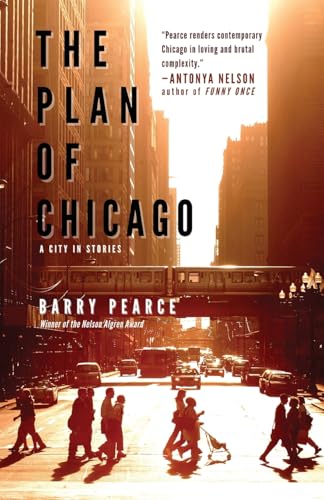
The Plan of Chicago: A City in Stories
Barry Pearce, Cornerstone Press
Many years ago, at a bar on Chicago’s northwest side, a deeply white area which to outsiders would seem entirely homogeneous, an old Irish guy in a political conversation was overheard razzing another old guy for saying something untethered from reality, laughing about how he was such a Bohemian.
To an outsider, this would probably imply an artist or a free spirit, the common connotation of that term. But in this Chicago neighborhood, it meant (in a friendly way) a rube, a dummy, an unlettered fellow. This is a Chicago where the color of your skin matters deeply, but is just the beginning of a million signifying partitions.
It’s this Chicago — all of the divisions of Chicago, and the fissures where the city divides and clashes together — that make up Barry Pearce’s shattering collection of stories, The Plan of Chicago. His stories are deeply-lived tales of lives on the edge, where money and family and neighborhood weigh deeply on every breath, and where there is no escape from the material reality of your life.
Pearce is often compared to Nelson Algren, the poet laureate of Chicago’s grit, and rightfully so. They work in the same alleys: down and out, striving, struggling, on the make. And while this comparison is earned, there’s a less famous Chicago writer to whom Pearce can be more readily compared: James T. Farrell.
Farrell also wrote of Chicago’s neighborhoods, and the people in them. Usually poor, usually ground down by capitalism. His genius was fully inhabiting and recreating the inner lives of people whose inner lives were smothered by constant fear of money and terror of change. He wasn’t as poetic as Algren (who was?), but that was also a choice. The people he wrote about were largely inarticulate, and he never gave the reader a chance to step outside the smothering reality of life to breathe in authorial remove.
Pearce inhabits the same kind of realism. There aren’t many sentences where you whistle lowly and say hot damn, that’s a sentence. There’s never a line like Algren’s “never a lovely so real.” Instead, he captures with heartbreaking precision broken hearts and broken lives.
Take O’Sullivan (known, invariably, as Sully), the protagonist of “Chief O’Neills.” A painter, he gets into another fight with his Polish boss, and can’t take it anymore, and talks back too much. Told he’s gone too far, he reflects “I guess I did. I fought with Jabo plenty before but always left the door open a crack, wide enough to creep back next week. Who knows why I closed it this time. Some lines you can’t see even after you cross them.”
It isn’t poetry, but it’s true. It’s how a person shrugs their rationalizations. Sully isn’t a dummy; he’s a good painter and starts his own business, getting work at Chief O’Neill’s (the bar in Chrysler Village, a dot of white on the Southwest Side, where he and everyone he knows have been drinking since they could drink) and then expanding. He and his partner, a childhood friend, bring in someone else, on a recommendation, who turns out to be Black (or as Sully says, casually a shine, a throwback slur you still hear in white neighborhoods).
It’s initially uneasy, but Pearce shows how they get over it in a gradual, non-didactic, normal sort of way. They bond as tradesmen who respect each other’s work will sometimes do. Sully even brings him into Chief O’Neill’s one night to celebrate the success of their biggest job. That doesn’t go well. The owner, who has been serving Sully since forever, says “‘Jesus, Sully, are you blind? You can’t bring him here.”
Sully, who before might have been as angry as anyone that there was a Black guy in his white bar, vows to never return. But then, “There’s too much history to finish like this…but already, the thought of passing O’Neill’s to drink at the Warsaw hurts my gut. It’s too high a price to pay, too big a trade.”
There’s too much history. That’s the heart of many of Pearce’s stories. The history of where you’re from, who you grew up with. What you’ve done. Where you came from, whether one of the neighborhoods or the person you used to be before you became the person you pretend to be. There is one story, “Creatures of a Day,” where the narrator’s act of sexual violence in his past becomes gradually more clear until it nearly strangles you with shock — but still feels everyday, more horrific by its quotidian nature, and the way he tries to lie to himself.
Every story is anchored in a neighborhood, which Pearce understands with anthropological and geographic exactitude. And they aren’t all about down-and-outs, even if one is literally about an immigrant father who uses his son to stage car accidents for money. There are aging hipsters, sad Gold Coast widows, people who left the South Side and got a suit-and-tie job up north. But they are all recognizably real people, living small lives — or rather lives that are their own interior epic, even if they will never have poems written about them.
The most artistic a story gets is one where a woman from a South Side family tries telling a funny story of going to meet her first girlfriend in Lincoln Park during a blizzard. She’s told it before and has gotten a lot of laughs. But in this telling, each iteration and emendation reveals more heartbreaking and tragedy, as we shift perspective, not as the reader, but as the narrator understands more of her hurt and the pain she caused.
And that’s sort of the point. Lives intersect with others, like streets on Chicago’s grid. Sometimes they are people you’ve known your whole life, and sometimes they are strangers. Your life runs up against partners or friends or lovers or parents or children, but in the end all you have is your own interiority. Your own history. Your own past and your hopes and fears and what’s weighing on you with each greying hair and each unopened bill and each memory you’ve tried to forget or retell to get through the day.
That’s what a city is made up of: these millions of interior monologues, some poetic and some inelegant and all unsure and all alone, smashed together to where no one is truly apart from anyone else. Pearce’s great feat is to capture the inner rhythms and how they spin into the lives of others.
The Plan of Chicago was the idea of Daniel Burnham, a vision of the city for the 20th Century. Wide streets, more parks, better infrastructure. It was how a city would be built anew. It was grand, and bold. But the city is made of people. Of neighborhoods that are more a state of mine than lines on a map. Of lines we draw around ourselves, and the fragile ones we use to connect to other people. Pearce capturing these lines gives us one of the finest visions of this brawling and sentimental and rough and literary city ever put to paper. This collection is equal to the task set out by Farrell and Brooks and Wright and Algren: to tell the stories of people too tired to tell their own, exhausted by the work of life, and of building the life of a great city.
Brian O'Neill
Brian O’Neill is a freelance writer living just north of Chicago, along the lake. His focus used to be on international politics, specifically in the Middle East, where he specialized in Yemen. His writing on that topic led him to explore the relationship between the environment, natural history, and current events, a theme which has carried through his work. More recently he’s shifted from the Middle East to the Midwest, with many of the same themes. Brian has written about books for The Chicago Review of Books, The Cleveland Review of Books, Necessary Fiction, Yemen Review, and other publications. Understanding the region, the environment, and the people inside it is his passion and project.