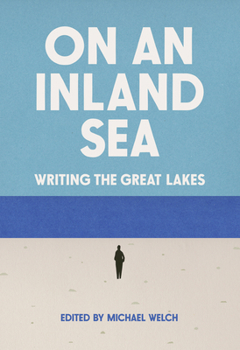
On an Inland Sea: Writing the Great Lakes (Michael Welch, editor)
Belt Publishing, 2026
Ridge Avenue runs through Chicago and the suburb of Evanston, a slight high point sloping down toward Lake Michigan, about a mile from its raging shore. I used to live a block east of Ridge, at the bottom of the hill — something that would be called a hill only in this glacial-flattened part of the Midwest — and on summer nights a kid would skateboard down it, taking advantage of this rare hint of topography.
I don’t know if he knew that the reason he was able to skateboard is because Ridge Avenue marked the shore of Lake Chicago, a proglacial lake fed by the retreating ice 13,000 years ago, and the direct predecessor of Lake Michigan. But that dried high point — which animals walked across and later became a well-known Indian trail and still later paved into Ridge Avenue — exists because of the power of the glaciers and the immensity of the lakes. Geology is why he was able to practice skateboarding in otherwise endless flatlands.
The role that the lakes, that water and geography and geology and the human forces that are shaped by and shape them, are the running theme in On an Inland Sea, an anthology from Belt Publishing edited by Michael Welch. This collection of personal stories and poetry from around the region attempts to capture life in the shadow of the seas.
In his introduction, Welch says, neatly, that “(t)his is a book about awe.” It’s a line both magnificent and nicely understated. Because the Lakes do inspire awe: standing on their shores they seem endless, but somehow more intimate than the oceans, more human. They can be a neighbor; not a force that shows how small we are in the world. Every piece in the anthology has the Lakes as either a central point or a jumping-off metaphor, but they are always there.
As Welch puts it, we’re reading “a collection of disparate voices that cross international borders and travel over one thousand miles from Duluth, Minnesota, to Rochester, New York, from communities as seemingly dissimilar as the metropolis of Chicago and the woods of the Upper
Peninsula of Michigan.” The book is about lives, which the Lakes give, even as they sometimes take.
It’s about awe: in “Prins Willem V,” Benjamin Madeska tells about diving around a shipwrecked freighter off the Milwaukee coast, in the dark cold waters of Lake Michigan, far from more bright and warm diving locations like the Caribbean. Looking at the 258-ft ship, nestled so close to a city, he writes:
“I felt the sense of menace and danger that shipwrecks exude. Beyond the punishing environment under the surface of Lake Michigan, there’s the palpable presence of the tremendous violence required to bring a ship of this size to rest. Diving here, you become aware of the power of the lake around you, and you have the realization that you are very much at its mercy.”
No one died on the Prins Willem V, but its nearness to Milwaukee can provide a slight uncanny shudder. I’ve often thought how horrible it must be to drown near a city, to go gaspingly under, again and again, an elemental death, while a million lights shine so close, so close you can almost hear the music coming from the windows of people you pray would turn and see and reach you.
The nearness of the Lakes provides that intimacy, and that awesome power.
Intimacy is another theme that shapes the anthology. The Lakes as a living metaphor, or a guidepost as people struggle through their lives. In “The Bound Body,” Martha Lundin uses the terrible winter of 2014, when Lake Superior froze over, to think about her relationship with her body and identity. While it is a struggle, there is grace. She writes, “After all, I haven’t figured out yet how people become themselves. It is because I am still becoming myself. Lake Superior and her basin had one and a half billion years to get to where she is, and she is still becoming.”
My father died in January of 2014, the morning the same record cold freeze Lundin describes hit Chicago. I remember walking with my oldest friend in a brutal blinding snowstorm to get another bottle of whiskey, and thinking not in metaphorical terms, but with the awareness that the lake and the weather and the cold had no concern for my little drama.
It is with this awareness that I am grateful none of the pieces in On an Inland Sea stretch metaphors too far. No, the pieces Welch chose are more interesting than that. The personal stories position the Lakes as a part of life, a childhood memory, an unchanging and ceaselessly beating force that anchors even as everything in our lives changes and becomes more confusing or harder. The uncaringness of the water can become a comfort.
Even in RS Deeren’s “Tree World,” which might be the finest personal story in the collection, a line that could be pedantic — “The inability of some to reconcile their impact on others is mirrored by their inability to reconcile their impact on the environment.” lands gracefully in context. The clashes within and between families, within and between generations, over the woods and hunting grounds are dwarfed by nature, even as Deeren recognizes our outsized impact on it.
The way we impact the Lakes, both great and minor, make up some of my favorite essays in the collection. These are less directly personal but no less intimate. A standout is “A Visit to Milwaukee’s Last Public Drinking Well”, by Lina Tran. Tran takes us deep underground, telling us that “Wisconsin is underlain by a series of aquifers, layers of porous rocks that hold water like a sponge.” It’s a story, like much else around here, of glaciers and time, of erosion, of layers of dolomite, of prehistoric seas over whose ghosts we’ve built our cities.
She toasts other fans of the last well, describing how she “sipped the ancient water—once snowmelt, rain, filtered through the wreckage of glaciers and stone.”
But her piece — the story of the wells — isn’t just geology. Tran focuses on the people who drink this water, who swear the well, and not the water coming from Lake Michigan, treated by chemicals. This, too, is the story of the Great Lakes: people who might not know what dolomite is, but whose most elemental need, that of water, is fulfilled by it.
We built on the shores of immense seas, themselves shaped by older forces. We built cities and economies around them. Lives grew and blossomed and were shaped and touched and blessed and wrecked around them. The iron around the lakes was dug to shape the country and fight a war and build an empire and the empire-builders were left with a wrecked land and dirty water.
These stories are told. So many never will be. But Welch and his contributors do an admirable job of showing the diversity of stories that are built on these shores, and how we continue to navigate our human relationship to one of the world’s great natural features.
I want to leave you with perhaps the most concise story, the one that sums up the vastness of the Lakes and the vastness of the lives on them is in Patricia Brubaker’s “Searching for My Father.”
“My mother told me stories of when my father would come into port. Sometimes the ship would anchor in the lake and my mother would be transported in a small dinghy down the river and out to him. She wore heels and stockings and painted her lips red. Her hair was permed.”
The port: where the ends of our cities turn into the beginning of the water. The port: that crux of human joining and leaving. The port: where sailors left for weeks and months to carve out a life and turn the Lakes into an engine of commerce. These sailors whose ships sometimes sunk into the cold. Whose families were left behind. Whose loved ones made themselves up for a trip on a dingy dinghy, with excitement and sorrow, leaving the shore into an inhuman darkness, to continue their stories, to keep writing these small and still-infinite human dramas. Their heartbeats are maybe drowned out — or maybe somehow amplified — by the endlessness of the waves.
Brian O'Neill
Brian O’Neill is a freelance writer living just north of Chicago, along the lake. His focus used to be on international politics, specifically in the Middle East, where he specialized in Yemen. His writing on that topic led him to explore the relationship between the environment, natural history, and current events, a theme which has carried through his work. More recently he’s shifted from the Middle East to the Midwest, with many of the same themes. Brian has written about books for The Chicago Review of Books, The Cleveland Review of Books, Necessary Fiction, Yemen Review, and other publications. Understanding the region, the environment, and the people inside it is his passion and project.