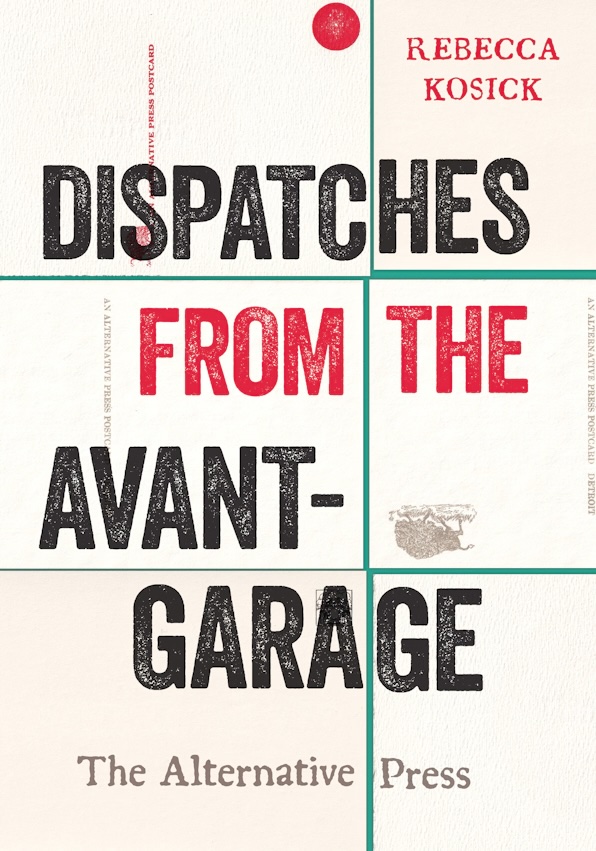
Dispatches from the Avant-Garage: The Alternative Press
Rebecca Kosick
Wayne State University Press
So often, when historians tell the story of the twentieth-century American avant-garde, they usually take us to Greenwich Village, the cafés and lofts of New York City where poets, artists, and musicians lived, worked, and pushed at the edges of their forms. Whether it’s the Beats in New York and San Francisco or the New York School and the loft musicians of downtown Manhattan, the standard account treats the avant-garde as a coastal phenomenon. Stories from the rest of the continent are few and far between.
However, this couldn’t be further from the truth. As many Great Lakes Review readers surely know, an expansive web of disparate, deeply rooted arts scenes that runs from Buffalo to Duluth. Despite this wide geographic span, these arts scenes in the Great Lakes region still haven’t gotten their due in history. Rebecca Kosick—an Associate Professor of Comparative Poetry and Poetics at the University of Bristol, UK, and a native Michigander—makes a strong case for one node of this web, Detroit, in her book Dispatches from the Avant-Garage: The Alternative Press.
The book focuses on the history and output of the Alternative Press: an avant-garde publishing operation founded in 1969 in Detroit’s Cass Corridor and run out of the home of artist Ann Mikolowski and poet Ken Mikolowski. Rather than books, the couple primarily produced ephemeral media such as postcards, broadsides, bookmarks, and bumper stickers — what Kosick calls “one-of-a-kind aesthetic objects”— they printed on their Chandler & Price letterpress and mailed directly to their network of subscribers. Over the course of three decades, their collaborators ranged from Detroiters like Jim Gustafson, Donna Brook, and John Sinclair to national figures like Allen Ginsberg, Robert Creeley, Amiri Baraka, Diane di Prima, Alice Notley, Ray Johnson, and Philip Guston.
Yet, despite such an impressive roster of collaborators, the press has remained a footnote in histories of American art and literature, as Kosick’s is the first book devoted to it. Across five thematic parts, Kosick does more than recount a local history that had gone unwritten; she shows why that history, and Detroit, matter to the broader story of the American avant-garde.
Kosick makes the deliberate choice to follow the press itself rather than its famous contributors, and that choice keeps Detroit at the center of the story. This is clearest in the second part of the book titled “Politics.” Kosick brilliantly traces the entanglement between the city’s political history and the Mikalowskis’ print operation. Founded after the 1967 Detroit rebellion, the Mikalowskis were part of a network of leftists, anti-capitalists, anti-racists, artists, and organizers who made up Detroit’s countercultural community.
Specifically, Kosick highlights their connection to John Sinclair, founder of the White Panther Party—an anti-racist, anti-capitalist political collective aligned with the Black Panther Party—and a major leftist figure of the era. Sinclair was among the press’s early collaborators, and the Mikolowskis published his poetry while he was incarcerated on a minor drug charge in a remote prison in Michigan’s Upper Peninsula. From here, we see the web of relations grow as the Press gains out-of-town recognition for publishing Sinclair’s work at this time, eventually drawing in other significant cultural figures such as Allen Ginsberg. Ginsberg stayed with the Mikolowskis in the summer of 1969 to write poems and raise money for Sinclair’s defense fund—which the Mikolowskis published. Kosick convincingly places the press’s output within the left-wing mobilizing of twentieth-century America, showing how a print shop on Avery Street fed into much larger political currents.
A unique feature of this book is how Kosick integrates archival Alternative Press publications into the work. Her narrative history begins with specific objects, which she reproduces in color throughout the book, and builds out from there. This is a compelling method, since every claim stays grounded in something the reader can see. It also opens the book to readers who aren’t specialists or don’t have a background in avant-garde art; they can experience the material for themselves in each chapter and see exactly what Kosick is describing.
This is integral to the book’s third part, where Kosick focuses on the intermediality of the Alternative Press publications. What could have been a typically dry, scholarly-oriented grouping of chapters does not read as such in the slightest. In fact, this is likely the strongest section of the book, in which Kosick dives into the press’s most distinctive offering: the bumper sticker.
Beyond their novel intrigue, the Bumper sticker is particularly iconic of Detroit at this time, as its large auto industry was beginning to dissipate. This offering was also very unique to the Alternative Press, once again highlighting the Press’s strong sense of place. Kosick shares stickers by Diane di Prima and Robert Creeley, reading their poetics and visual design together. Stuck to a car, a poem went straight to its audience, sidestepped the gatekeepers of high art, and became poetry people experienced in their day-to-day lives—“functional works of art,” as Kosick claims.
These ephemeral publications highlight the collaboration inherent in any artwork. This is clear in Kosick’s discussion of postcards: a design or poem on a card is “by” an individual artist, but it is published and attributed to the Alternative Press, and because it is a postcard, subscribers used the back to write their own messages. A single card could carry the work of an artist, the editors who printed it, and the person who mailed it. Kosick uses examples like these to show how artists, editors, and collaborators shaped each publication and one another, and to argue that destabilizing individual authorship was inherent to the press’s ethos.
What is likely one of the book’s most unique offerings is the extensive gallery of archival images of Alternative Press publications that occupies the end of the book, displaying treasures such as a Charles Bernstein bookmark and an Edward Sanders bumper sticker. This addition provides“art-book” appeal, as readers could spend just as long sifting through images as they did reading the text.
Dispatches from the Avant-Garage succeeds as history because it translates the archive to readers almost seamlessly. Kosick lets the material speak for itself, developing her narrative through it instead of imposing a neat chronological form. History is messy, and Kosick does a brilliant job embracing that mess while also crafting a fun, engaging book for a wide-ranging audience. This book is for scholars, but it is just as much for Michiganders, artists, poets, your local DIY scene, and anyone who just wants to look at pictures of beautiful bookmarks and bumper stickers. Kosick’s pays deep homage not only to the Alternative Press, but also to the rich history of DIY arts culture in our region.
Noah Steele
A Buffalo native, Noah is a musicologist whose work brings urban studies into discussions of music and sound. His current projects focus on Great Lakes cities, where he examines the social and material effects of late twentieth-century deindustrialization on art-making. He is pursuing a PhD at Northwestern University, where he is a fellow in the Mellon Interdisciplinary Cluster in Global Avant-Garde and Modernist Studies.
In addition to his scholarly work, Noah is a double bassist, having performed at Carnegie Hall, The Kennedy Center, and a variety of DIY venues across the US and Canada. He has also previously taught double bass as an instructor at Interlochen Center for the Arts.
Noah reads widely, from academic monographs to novels to more experimental poetry. Regardless of genre, he is drawn to the ways writers connect to the Great Lakes and the choices they make in translating that connection for readers.