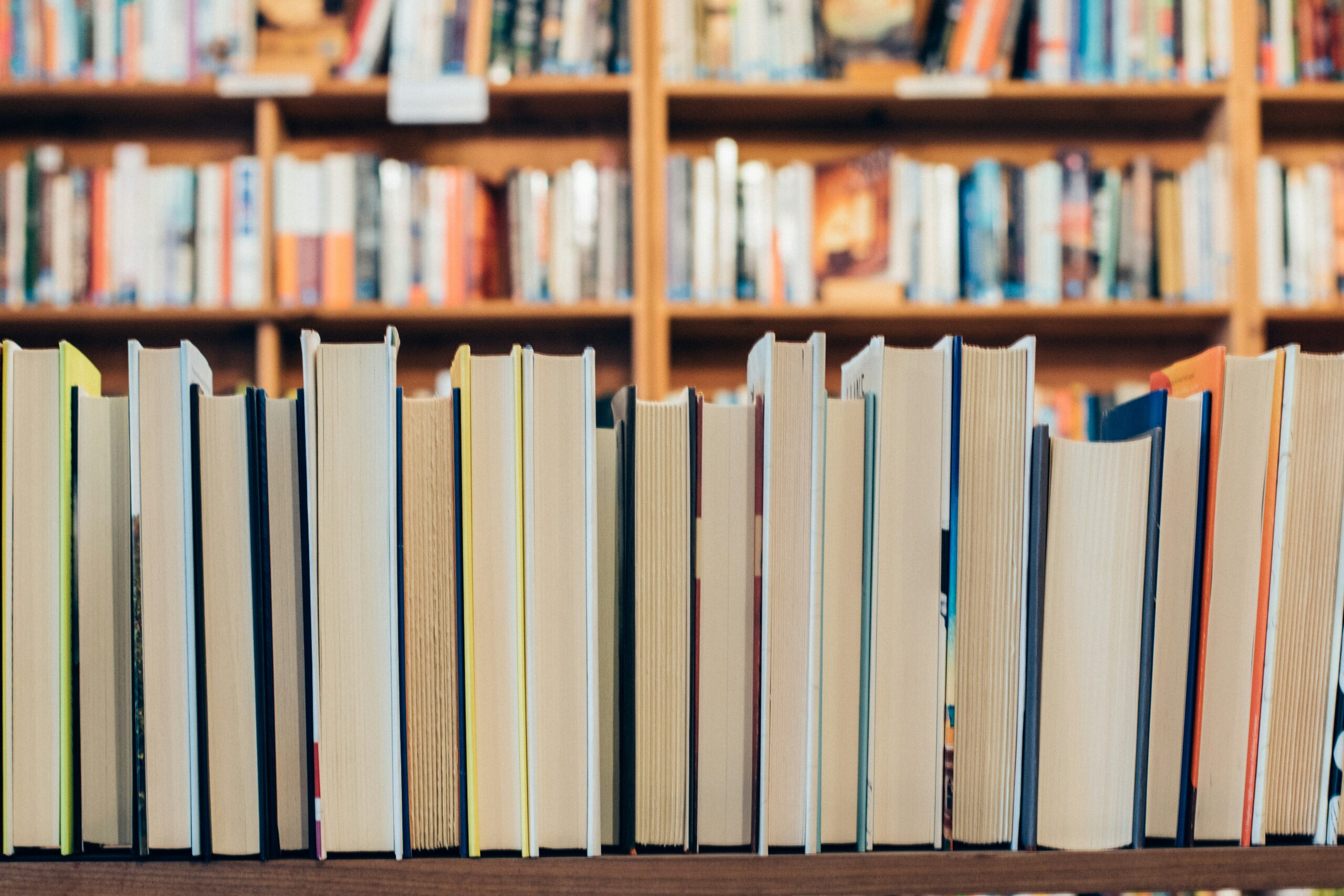
The downtown branch of the Spokane Public Library housed 16,312 children’s books circa 2013, enough to last my five-year-old middle of three kiddos, there for the first time, her next half-decade if she read nine each day. Mere minutes into our being on the premises, my kindergartener—a bibliophile in the making—began wandering the rows, touching the titles, getting her balance, balancing what she wanted to borrow. I tried to comprehend the changing looks of delight on her face. Can we take any of them? All of them? They’re free? You’re sure? How many should we get? Six? Six hundred?
She put down her pile on an empty table, picked up the top book, opened it, stuck her nose in its spine, and sniffed. Four years from then, I’ll be driving my trio of bambinos home from school (“…I filled the whole front page / With the catchiest words I could find,” the New Pornographers—one of the few bands they’ll agree on—likely belting out from “The Fake Headlines” as my moppets participate in bursts of sing-along karaoke, “Believe me, come back…”), and then unprompted—as if mystic magicians making meaning appear out of nowhere—they’ll take turns describing what books smell like to them. I’d tell you it had something to do with scent “X” for one, and odor “Y” for another, and totally aroma “Z” for the third, but I can’t violate their trusts and fill in those blanks with similes that belong to them, metaphors too personal to be part of my account. But I will tell you this: my wee ones will switch subjects suddenly to stuff like xeroxed butts or yo-yo parades or zebra burps, and then, while giggling at their shared silliness, they’ll take turns making other veracious statements, as if their every sentence acted on the others the way Wonder Woman’s lasso could in the comics.
“So, like, are all these books…,” asked my daughter in the library that afternoon, “true?” (I’d made a note of it when we got home.) I looked at her as we walked to check out, nodding a chuff and a chuckle. “Like, for real and for true,” she said, using a phrase our jokey household employed to make the listener aware of our sincerity, our probity. “Or just, uh, make-believe-ness?”
My darling, I should have told you that the truth is the term “nonfiction” dates to Boston Public Library reports from 1867. The truth is the American Library Association code of ethics includes (as updated in 2021) their intention to “uphold the principles of intellectual freedom and resist all efforts to censor library resources.” The truth is Jeanette Winterson wrote—in her 1985 novel Oranges Are Not the Only Fruit (oft described as semi-autobiographical fiction) and from the perspective of first-person character “Jeanette”—this truism: “In the library I felt better, words you could trust and look at till you understood them, they couldn’t change half way [sic] through a sentence like people, so it was easier to spot a lie.” The truth is the largest library in the world is the Library of Congress, built as a repository (of annals, analyses, narratives, numbers, and even bits of old erotica) originally to benefit the members of the U.S. Congress whose relationships with honesty are somehow more relative than spacetime. The truth is we perceive whatever the “now” is—whether we’re currently yowling rock songs in the car; or whiffing the potential made kinetic as a hardcover binding gets cracked open; or ambling the stacks with our amazed child—as individualized realities received by our brains after its happening (our respective presents are various pasts) and processed by our otherwise confused consciousnesses as if synchronous. The truth is active (“Our friend here has given us a great idea! We’ll just put the books in any damn place we choose!” yells Parker Posey as then-sarcastic library clerk “Mary” in 1995’s Party Girl) as an indie thespian pretending, performing an actuality. The truth is—according to the no-hiding theorem of quantum mechanics and the relativity of simultaneity—information disperses into decoherence but evades entropy’s effort to make it go kaput: put pithy, information lasts. The truth is any “truth” (including all those) is only a partial possibility, a vague maybe, a hope. Thankfully, that truth is good enough to go on.
Yes, that truth is good enough to go on, and yet, I miss meeting my second-oldest friend (also named Matt) at a public library story hour when we were both but four. I miss going to the tiny Ransomville Free Library when we lived in an exurban hamlet and delving into its 1,200 square-feet felt full of more potential than even the Great Library of Alexandria ever had, the modest options available offering me a kind of imagination tourism. I miss researching Texas for a fifth-grade essay while in the Clearwater Public Library, there while vacationing in Florida with my nuclear clan as we visited extended family. By the middle of middle school, I liked libraries so much that a friend and I created an interactive computer application about the Dewey Decimal System for a New York history day competition held in Albany. When I had to use the Niagara Falls Public Library to explore the trajectory of special effects in films, I could be sure my high school homework might prove challenging. When my folks schlepped me to the University at Buffalo to dig through data needed to finish a paper, I saw how scholars took learning seriously as a bill of rights and its guaranteed freedoms. I miss witnessing fireflies (rising from the grass and skywriting messages to one another) outside Alden Library on the campus of Ohio University during my first year of college; and I miss reading American Revolution-era newspapers on microform in Milne Library while finishing undergrad at SUNY Geneseo; and I miss walking into Thompson Library, while enrolled in a graduate program at Ohio State University, feeling that outrageous level of omnibus access, feeling that humbled, that excited; and I miss pouring over political tomes inside the University of Idaho Library, the largest in the Gem State, as I studied my way into three jobs as a campaign manager. Any truth is good enough to go on, and I wish I could somehow reshare these adventures with my youngster. I wish our time wasn’t so impossibly temporal, linear, fleeting, fast. Who knows what other findings await us regarding the so-called “fourth dimension?” Who knows what other ways it can be experienced? Truth is good to go, and knowledge begets more knowledge, and more knowledge begets wisdom, and wisdom begets alterations to the cosmos, alterations that zoom us beyond the zenith of being. A library is as holy to me as a church, a museum, a park made for dogs, and I miss each instance of a librarian nodding a smile of approval at the book I checked out, maybe one about pancakes, maybe one about jazz.
Back in the Spokane Public Library, following my daughter’s question about facts versus fabrication and as we set the books to be scanned on a counter, I probably tilted my head from side to side, stumped for the right words, aware the world as we encounter it is all loosely based on bona fide fairy tales: all of existence is chronicle, new journalism, parable, ekphrasis, haibun, “Dear Diary.” I don’t remember how I answered her question. But books and atoms and asteroids and everything—it’s all guilty of being echt-ish, my dear one. It’s more than what’s known doing that which it does: in part, a universe observing itself, perusing endless shelves electromagnetically onward. Tomorrow becomes today and becomes yesterday. It is. It was. It is. It was. I wanted to say it then, but at least I’m saying it now: oh, my sweet everything, even the world itself could not contain all the books that should be written, and all the books written are real and make-believe, since this improbable life will never be this truth (this way, this when, this shape, this place) again.
Matt Zambito
Matt Zambito is the author of The Fantastic Congress of Oddities, and two poetry chapbooks, Guy Talk and Checks & Balances. His nonfiction has appeared in Fugue, The Inlander, and The Ohioana Quarterly, and new poems are forthcoming in Swamp Pink, Tampa Review, Heavy Feather Review, Slipstream, The MacGuffin, and elsewhere. Originally from Niagara Falls, he has lived in Ohio, Idaho, Washington, and New York, where he now resides with his rescue dog, Sadie.