Hello and welcome to this brand-new space! My name is Meredith Hoogendam, and I am excited to step into the role of Literary Columnist for Great Lakes Review. Columns are special beasts, as implied within the writing is an ongoing dialogue with the reader. I am grateful to be here, in conversation with folks who celebrate, champion, or are simply curious about the cultural landscape undergirding the unparalleled Great Lakes bioregion.
Together we’ll explore the complex web of connections inherent to the artistic, literary, and storytelling community specific to the Great Lakes. We’ll ask questions: What does it mean to be of a place? What does it mean to belong as a human being, a meaning-making animal, to a particular ecological bioregion? And finally, how does art-making in relationship, in collaboration (with one another, with the land and water, and with beyond human animals) reflect the very deepest nature of our actual and symbolic dialogue with one another as members of a shared community of being? I look forward to exploring these questions together as this space evolves.
And because I’ll be using this word a lot going forward, I’d like to throw in a working definition for the term “bioregion.” Here’s a simple one that I really like:
A bioregion is, in its simplest formulation, a life-place…Etymologically, a bioregion is a life territory. Every person, animal, and plant lives in one. It is a geographical area defined not by political agreements but by the patterns of the living world: its watersheds, soils, elevation, climate, plant and animal communities, and the human cultures that have grown in relationship with these features over time. (Department of Bioregion)
The Way of the Forager: Creative Practice in Community, Part 1
I’ve been living in Ontario, Canada for more than twenty years. As it happens, I’m in good company; approximately twenty-five percent of all Canadians live within the Lake Ontario watershed. Lake Ontario, smallest of its kin and direct line to the Atlantic Ocean via the St. Lawrence River (as the inestimable Ontario poet Sadiqa de Meijer writes, “The lake has the sea on its breath”), is also the most heavily populated–and, to many minds, the most environmentally threatened of all the Great Lakes. In this watershed alone one can witness patterns of extraction and patterns of relation both, as the human community negotiates what it means to draw from and live within a landscape defined by thousands of years of push and pull, glacier to rock, lands to waters, hands to industry.
I have come to love this particular patch of the Great Lakes bioregion in all its geographic and poetic diversity, a collage of shield and glacial till, wetlands and lowlands, eskers and drumlins, towering maples and black oak savannahs. Here wild rice grows, salmon spawn, and a woman can wander for kilometers in a canoe, foraging for cranberries and lost time.
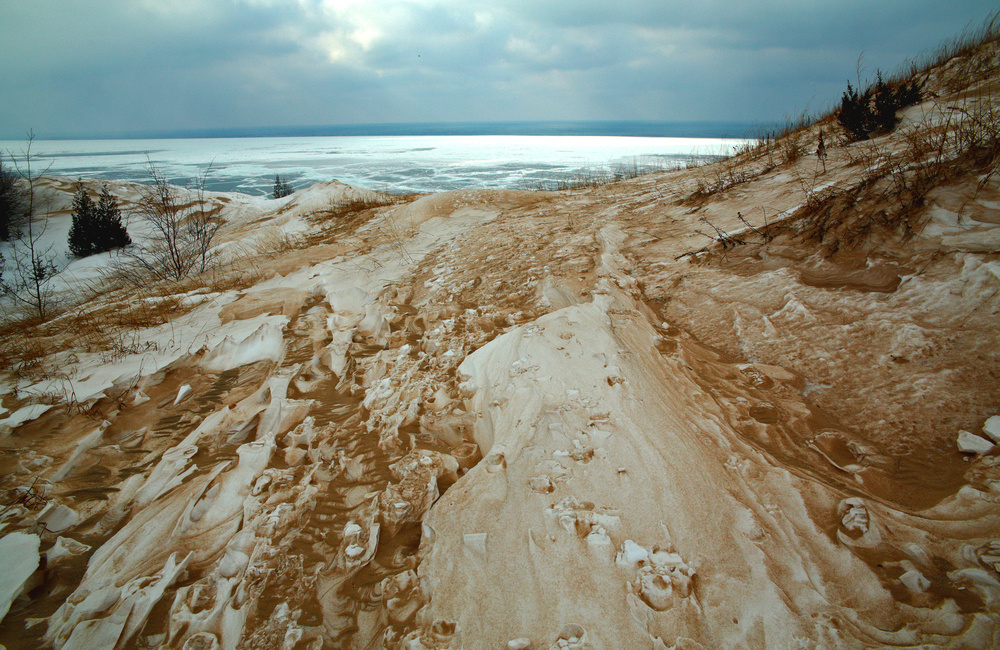
Still, roots summon. Alongside my maternal line for generations I hail from Northern Lower Michigan, just south of Sleeping Bear Dunes National Lakeshore. This place is special the way all places are special, if you’ve come to love them enough. Terrestrially, my homeland is a veritable eighth wonder of the world with its somersaults of rolling, towering dunes and apparently endless shoreline along Lake Michigan’s eastern edge. This particular curvature of sand meets water, a coastal fingerprint familiar to those who’ve witnessed it, is tattooed on my innermost being. Like ducklings, it seems a person’s first encounter with Mother Earth leaves an imprinting, an indelible mark. Some of us chase that numinous high for the rest of our lives, a natal connection to the site of our origin; a recognition beyond language, beyond time*.
I’ve spent the last few years considering this connection, working it through in my artistic practice. As a writer and interdisciplinary artist, my curiosity about what it means to be of a place has led me to wend my way through the questions via a whole host of mediums: poetry, visual art, collaborative performance, short films, and even into elementary classrooms, where young artists spent time drawing portraits of the at risk and endangered animals indigenous to our Great Lakes bioregion as part of a community collaboration rooted in bioregional care and craft.
It’s been a trip, this practice of curiosity, and it’s the trip of a lifetime, because the journey toward understanding oneself first and foremost as a member of a larger, biological organism is equally disruptive and enlivening. Seeing ourselves through bioregional eyes disrupts other (capitalistic, nationalistic) narratives about who we are, why we are here, and to whom we belong. Recognizing our inherent connection to our surroundings and the plants, animals, fungi and forests within our community can be life-giving, even healing; a kind of homecoming.
We who are curious about what it means to identify with the beyond-human community must necessarily feel out our place within what poet Mary Oliver calls the “family of things.” In this way, we navigate instinctively through questions of place and space. What elements define the very particular space in which we find ourselves, from cloud and canopy to root and rhizome? And what is our unique place within it? To what and to whom do we belong? Who and what make up our community? To whom do we owe our time, energy, loyalty, respect, and commitment?
As it turns out, I owe my time, energy, loyalty, respect, and commitment to Northern Cricket Frog, Grasshopper Sparrow, and Northern Brook Lamprey. I owe them to Bogbean Buckmoth, Shortjaw Cisco, and Wolverine, among so many others. These beyond-human animals–threatened, endangered, and indigenous to the Great Lakes–don’t draw lines along imaginary national borders. They don’t collect my taxes. They don’t search my car or scan my passport. Their home extends beyond the land and waters we call Ontario, and across and around the land and waters we call Michigan. They are citizens not of a governmental affiliation, but of a watershed; a living, breathing, bioregion. And as it turns out, so am I.
After traversing the province for nearly decade, my partner and I landed on a small cabin just north of Lake Ontario. Round about our second spring, I fell homesick. My parents were ill and Michigan was galaxies away. I longed for sharp dunegrass and grey reindeer lichen. I pined for the invasive purple star thistles that make Sleeping Bear Dunes area honey so unique. I yearned and my whole body felt the pull, as if my being were sinking downward into the soil.
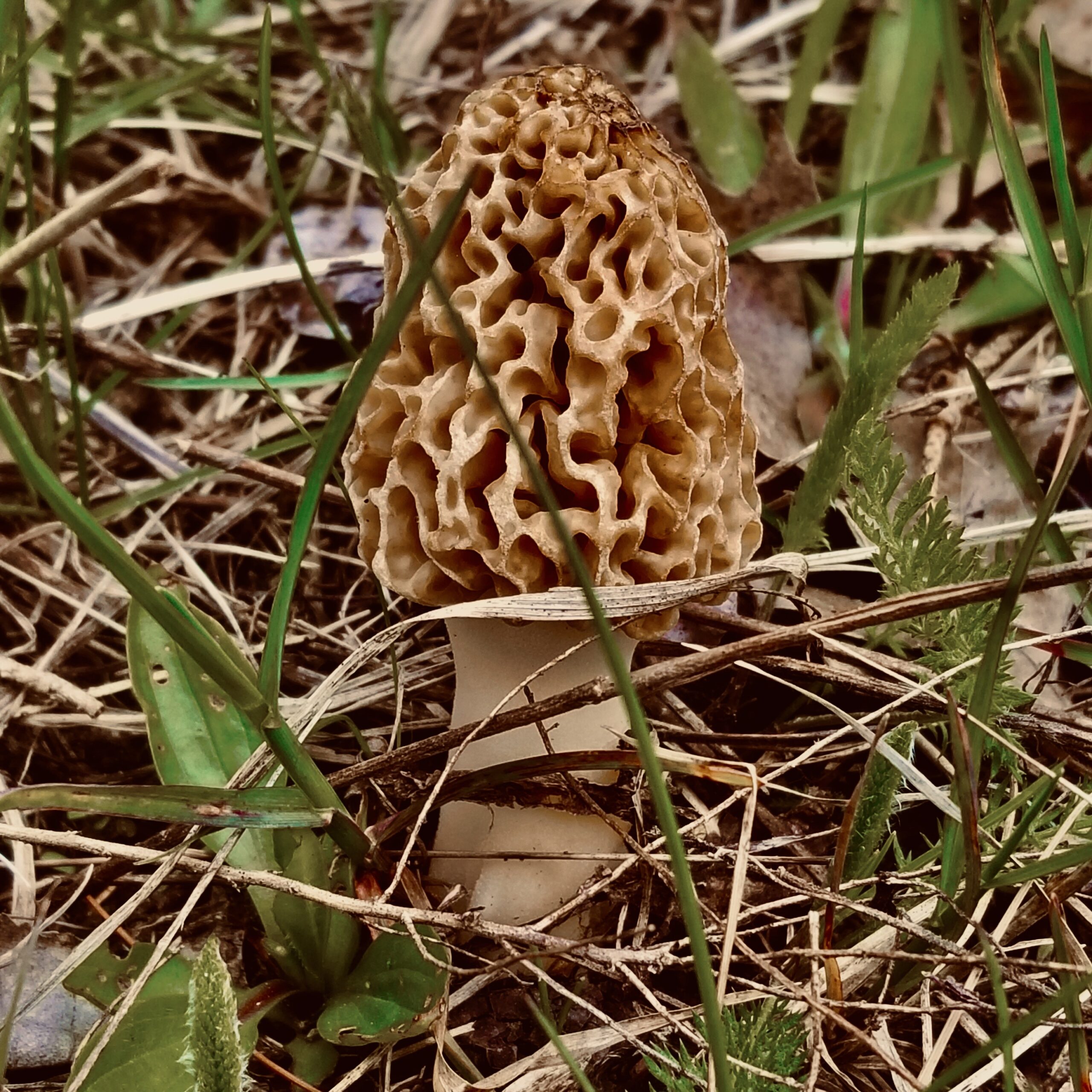
In this fugue I floundered until one morning my partner called me to come outside. It was early May, just around the time of the Mesick Morel Mushroom Festival, an annual “up north” tradition. I had heard there were morels in Ontario, but I had yet to see one. Beckoned from my dusky cocoon, I ventured outdoors to find my partner, shining and smiling under a wizened old apple tree. Look! he said, pointing to a spot beneath the tree. I squinted, crouched close to the soil. Like Venus from the sea, rising from a thick layer of ochre and umber leaf rot was a comely morel mushroom, plump and proud. I sank to the ground and wept.
In the time since, the phrase “wood wide web,” the idea that forest and plant communities are connected by an underground mycorrhizal network (as established by Canadian writer and conservationist Suzanne Simard, professor of forestry science at the University of British Columbia), has become common parlance. We know now that trees and fungi have colossal root systems that can span miles underneath the surface of the earth, and that these root systems allow them to communicate with one another, even send nutrients and healing agents to one another, from across a vast expanse. From where humans stand atop Earth’s surface, we may only encounter their trunks, branches, and fruiting bodies. But below, the interconnectedness of resources, relationships, collaboration and reciprocity is astounding.
The morel under the apple tree that day spoke to me of this interconnectedness, before I had the scientific language of the mycorrhizal network to express the sacred poetry I was witnessing. Sitting at the base of the tree, I was transported–“port” being the nominative root here, as in portal–to my parents’ ramshackle, red house where morels gather every year in the ancient orchard. The morel by my side in southern Ontario was poetically, if not literally, in relationship–in conversation, in community–with the morels in my parents’ Michigan orchard. We weren’t so separated, after all. It seems a watershed will reveal stories of community, connection, and collaboration if we know how to listen, and where to look.
This fungal encounter was the beginning of a journey toward understanding myself not as an American or Canadian, but instead as a citizen of a more essential, even existential place, with borders crafted not by the imaginations of men, but by natural distinctions in flora, fauna, landform and watershed: The Great Lakes bioregion.
In the time since, I have encountered many more morels within the Lake Ontario watershed. Beneath a beloved old butternut tree: three morels, just after my dad’s death. A coterie of morels in the sand and duff under the swing set where my children tromp and play. And lo and behold, one spring morning: as my eyes adjusted to the dawn light, mushroom upon mushroom materialized across my field of vision, morels sprinkling the pathway through the garden, leading right to my door. It seems the more closely I look, the more deeply I see. With bioregional vision, there is no such thing as isolation, no us and them. Everything, connected. Everywhere, home.
“What is Bioregionalism?” (deptofbioregion.org)
“Lake Ontario Park,” Sadiqa de Meijer (poetryfoundation.org)
*Beyond Time, Gwen Frostic (Presscraft Papers, 1971)
“Wild Geese,” by Mary Oliver (Wild Geese, Selected Poems, Bloodaxe Books, 2004)
Meredith Hoogendam
Meredith Hoogendam is a Great Lakes bioregion writer, educator, and interdisciplinary artist. Originally from a village near Lake Michigan’s Sleeping Bear Dunes National Lakeshore, she divides her time between the north shore of Lake Ontario and an island at the confluence of Lakes Huron and Superior.
A member of the Writer’s Union of Canada and League of Canadian Poets, her work can be found in publications across North America, including Great Lakes Review, Room, Geez, Mutha, Untold Volumes, catapult, and Topology magazine, among others, as well as “Word on the Street” Toronto, and in several anthologies of regional literature. Liminal Spaces (Glentula Press, 2025) is her fifth book of poetry. Her visual art can be found online and in print, including as cover image for Where Sun Meets Shadow: Poems, Felicity Sidnell Reid (Aeolus House Press, 2026).
Meredith is deeply invested in her hyperlocal arts scene and creates poetry and storytelling programming for her community radio station. She has served on editorial boards for literary and educational journals, as copy editor for a longstanding newspaper, and on arts and culture initiatives within the Great Lakes region.A watershed artist and advocate, Meredith embraces the opportunity to work alongside the Great Lakes Review community in celebrating the power and vulnerability of our unparalleled bioregion.
Find her at: merkatart.substack.com