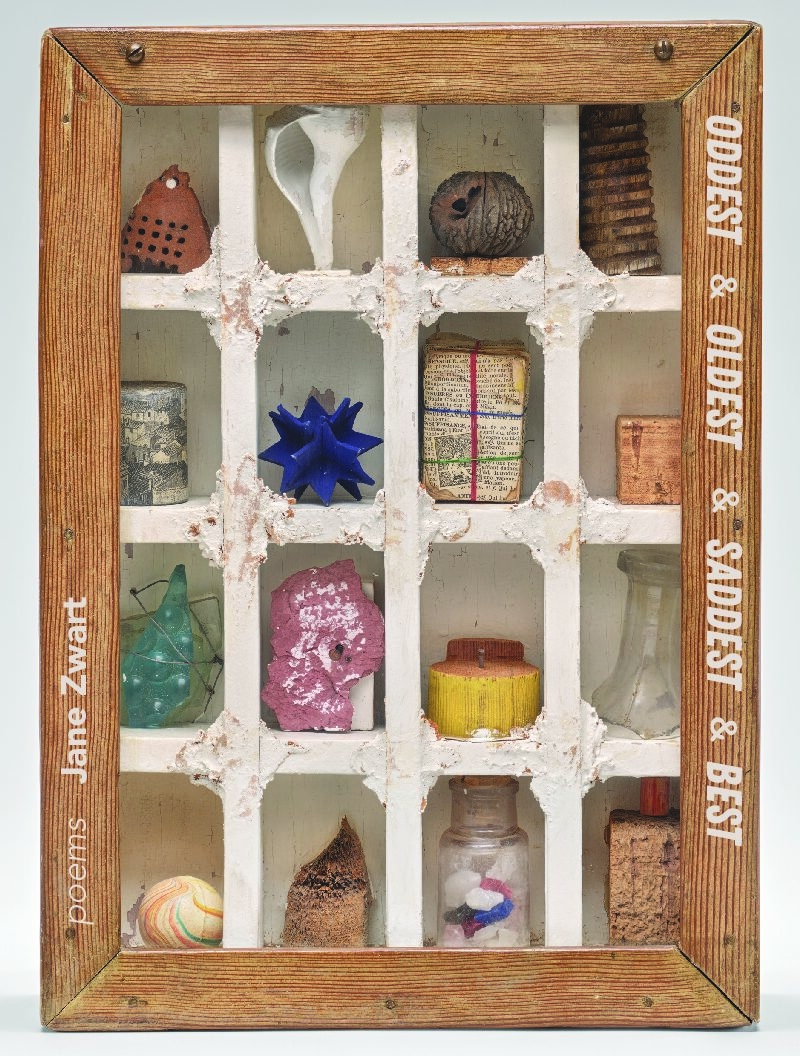
Oddest & Oldest & Saddest & Best (Orison Books, 2026) is Michigan author Jane Zwart’s debut book of poetry. A professor of English at Calvin University and faculty fellow of the Calvin Center for Faith & Writing, Zwart is also co-editor of book reviews at the poetry journal Plume and has a long list of published poems to her credit. Reading Oddest & Oldest & Saddest & Best felt like meeting a new friend who has been gathering wisdom that I happened to need—it reads like the final product of a careful distillation process. In the opening poem the speaker wishes to “watch the filmstrip” of her life once it has ended, confessing,
All my life I was a bride married to amazement:
every sickness an affront, every peach
a geode. All my life: bowled over by every hell—
fresh, stale, it didn’t matter—
Unsure whether she will have passed life “as surprise’s adept/or her dupe,” she takes both the strange and the stunning with straightforward acceptance. There is a forbearance in this that fosters curiosity rather than resistance or hostility, that opens the reader to looking more closely at the world than they might ordinarily. I spoke with Jane Zwart to learn more about her process of observing and writing that resulted in this beautiful poetry collection.
GLR: What is your personal history as a poet?
Jane Zwart: Both of my parents were English majors in college so there were a lot of books in the house, and the Yankee Clipper Library was in short walking distance from home. So, I have been a reader for a long time and loved words, sounds, and wordplay. They were in the air I was breathing from the beginning.
I found poems in my parents’ library and in the hymns on Sundays, which makes for a strange combination, but I liked something about the use of language that broke sentences into lines and relied on cadence and inter-rhyme. I enjoyed that way of being in language, so I read e. e. cummings and Langston Hughes and Emily Dickinson and concentrated on the words of the hymns that I liked. I began to play with writing poetry in 5th or 6th grade. My parents were encouraging, and my mom put strange vocabulary words on the fridge in the summer—and that lesson in paying attention to the weird variety of words in the English langauge was useful, so I have my parents to thank for that background.
That said, for a long time I thought I needed to wait for inspiration before I could tuck into a poem, but one thing that helped change my mind about that was meeting Amit Majmudar. He is a poet and novelist as well as an essayist, translator, and a radiologist, and I was lucky enough to interview him once. Afterward, back in the earlier days of Twitter, I saw a beautiful image of an angel at Christ’s tomb, and I thought the angel looked tired. I tweeted “I’ve just decided I prefer my angels sleep-deprived” and Amit zinged back “Prompt: write a poem titled The Sleep-Deprived Seraph.” I laughed, and about an hour later, he emailed me a poem with that title, then said, it’s your turn. So I sent back a poem, and we continued like that every day for a month. Of course the quality was uneven, but we both wrote things we would never have written otherwise. And that’s how I realized that a poem doesn’t need to be delivered whole by the poetry fairy. You can draw a shape and then try to fill it in.
GLR: I notice that most of the poems in the book were published individually in journals. As you were writing and publishing did you have the idea for this book in mind or did that come later?
Jane Zwart: This book took a long time to find a home, and there were different iterations of the manuscript that I sent out. And probably the earliest iterations weren’t ready; they weren’t the right mixtape that the book needed to be. So it took a long time to get my foot in the door. In fact, it felt like it was never going to happen. Then I was speaking with the poets Christian Wiman and Danielle Chapman at the Festival of Faith & Writing at Calvin University, and Christian offered to look at all the poems that were contenders for the manuscript, and he helped me find a book in there. Then I sent the manuscript to Orison and from there the editor and I made some more adjustments. I also had help from the poet W. J. Herbert in thinking about order and resonances between neighboring poems and where a surprise or pivot should come. All along, I think, there was a common sensibility between the poems in the book, but putting together a book is a whole additional weird art.
GLR: I love the title and the title poem. I thought it captured several themes I noticed in the book, particularly survival and savoring life. Were you working with certain topics or ideas as you were choosing poems for the book?
Jane Zwart: There are themes that are important to me naturally, partly for biographical reasons. Not everyone survives, and at some level no one does. I have carried this awareness with various levels of difficulty for a long time. And I’ve always liked the quirks and astonishments and beauties that are part of being in the world, though having kids is a masterclass in paying attention, to savoring life. That is in there as well.
But thinking about survival, as a person of faith, I’d say that even as no one has an earthly infinite survival, under all of it–this world and the next–there’s the hand of God. And trusting both things, the delight of this moment right now, alongside the hurt of endings and that this moment, this life, isn’t all–that’s the space I try to inhabit. Because I do believe in the precious impermanence of this life, and I believe in a divine rescue and a promise of more life. That rescue–or promise–doesn’t cancel grief, but it contextualizes it.
GLR: There are several poems about your brother Adam, and they indicate that he died when you were both children. How did writing about him affect your understanding of losing him, or of other kinds of loss?
Jane Zwart: Adam was seven and I was nine when he died, and for a decade I ignored his absence as much as I could; I didn’t know what to do with it. In college, my grief came back for me. But even then it wasn’t overt in anything I was writing. If I approached it at all, it was in a more abstract way, thinking about our perishability. Thinking about grief but not that grief specifically.
One of the things that made it come into my writing more was having kids myself. Nothing makes the stakes come into sharper focus than having children. And for me, being a parent forced my hand, and I’m glad it did. I mean, because of these people who I made and love desperately and can’t protect from everything, I’ve had to do serious work in my own feelings, and I’ve reckoned with what I believe. I’ve also learned how to use language as a provision to understand both grief and love
GLR: You are so good at endings. How do you write endings in your poetry? Do you write them early or do they come to you later, with revision?
Jane Zwart: Almost never do I know where a poem is going when I begin to write it. Usually, I have a line or an image from the beginning or early middle when I tuck in. Then it’s just play, seeing where the sounds and words and free associations go. And there are of course false paths.
I know I’m close to the ending when I feel the poem turning. I often write myself past the ending. There is a trick of doing a last line test: is the poem better without this last line? If so, then I pull it and ask that of the next line, and so on. I often find that the stuff in those overly explanatory lines that were cut is something I need to work into an earlier place in the poem. Or let go.
GLR: I found your poems rewarding to read because they had images that I didn’t always understand on a first reading, but they yield to an understanding on further reading, which is really satisfying. Can you talk about submerged meanings, or how you calibrate a poem to be clear but indirect enough to leave room for the reader to complete it with their own thoughts?
Jane Zwart: That’s part of what I find rewarding in a poem too. There are times when I tend too much in the direction of subtly or of overly elaborate (and impenetrable) language in a way that can make it hard to see the thing itself. I do worry about whether style or acrobatics are too much of a hurdle in my poems sometimes. I love strange and uncommon words, for instance, and I think quite a lot about whether I’m showing off or doing something more meaningful.
As poets, we have to decide where we want to be on the continuum of accessibility and play and ornamentation. For me, I like it best when a poem asks you to do the work but gives you what you need to get there. Sometimes, when I’m writing, I’m too stingy: only I have what I need to get to what the poem means to reveal, so I need to give the reader. The only way to get better at the balance, probably, is spending time reading people who are really good at this.
GLR: What writing are you currently working on or hoping to take on next?
Jane Zwart: Partly I’m doing what I always do, which is writing poems as they occur to me or as I find a new shape I can fill in. One of the things I’ve been working on is a project where I steal titles of famous works and write a poem that has nothing to do with the work itself. It’s fun to repurpose and half-misread them, using them as a jumping off point. I’ve also been writing a lot of poems that have to do with my mom’s diagnosis with thyroid cancer. She is doing well, but she also has a prosthetic voice now, so it’s not the voice she always had. Given our family’s history with cancer this is the thing I was most afraid of and it happened.When I asked how she felt about my writing poems about what is, of course, more her story than mine, she told me that if there are poems, I better write them.
GLR: What are you reading right now?
Jane Zwart: I teach at Calvin University’s prison program in the summer, so right now I’m reading our next book, Invisible Cities by Italo Calvino, which I adore. In poetry, I’m reading Catherine Pierce’s Dear Beast and Raphael Jenkins’s Paper Pistol. Christian Wiman’s The Dance is next on my list.
Emily Updegraff
Emily Updegraff is a staff member and an MFA student at Northwestern University. She has published poems in journals including Third Wednesday, The Orchards Poetry Journal, River and South Poetry Review, and Dialogue, and is a book review contributor at Great Lakes Review.