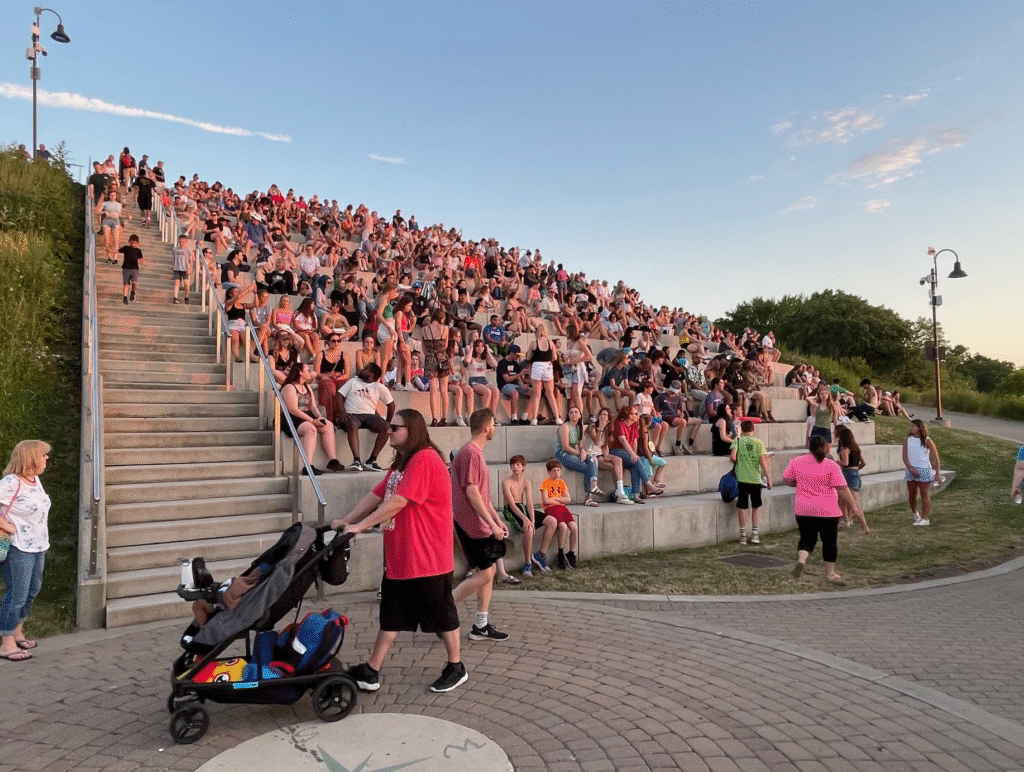
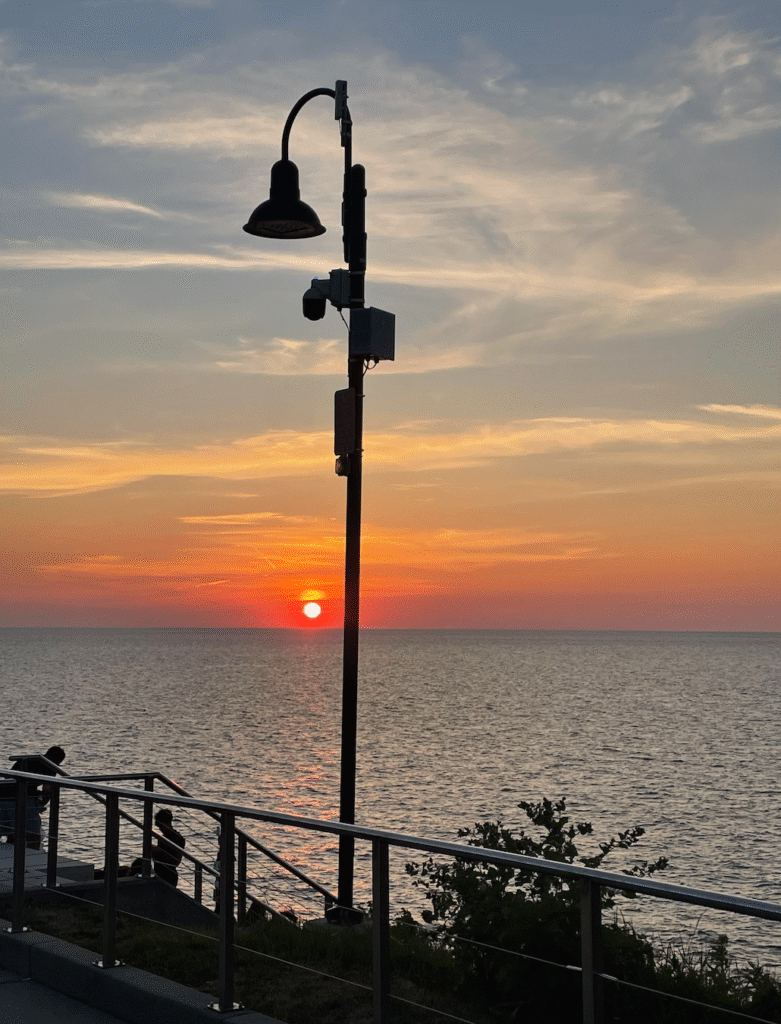
Have you experienced a sunset where humans applaud as the final trace of the sun disappears on the horizon? I’ve only experienced such an ovation at two glorious places: the famous South Rim of the Grand Canyon in Arizona, and the lesser-known Solstice Steps in Lakewood Park just west of Cleveland, Ohio. At the former, the expanses of the multi-layered canyon frame the scene. At the latter, the ever-shifting blues of Lake Erie provide the setting.
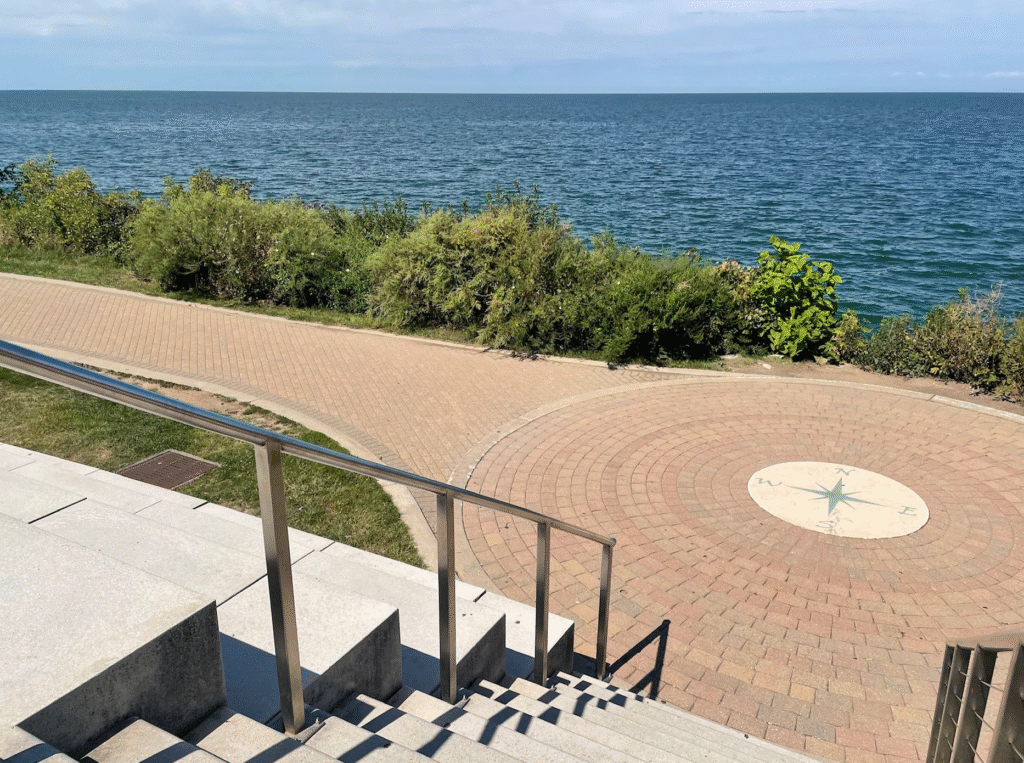
While the South Rim is a feature carved by nature over millennia, the Solstice Steps were carved by humans into a bluff overlooking Lake Erie in 2015. Since that time, they have become the main attraction of the largest city park in Lakewood, Ohio, the first western suburb of Cleveland.
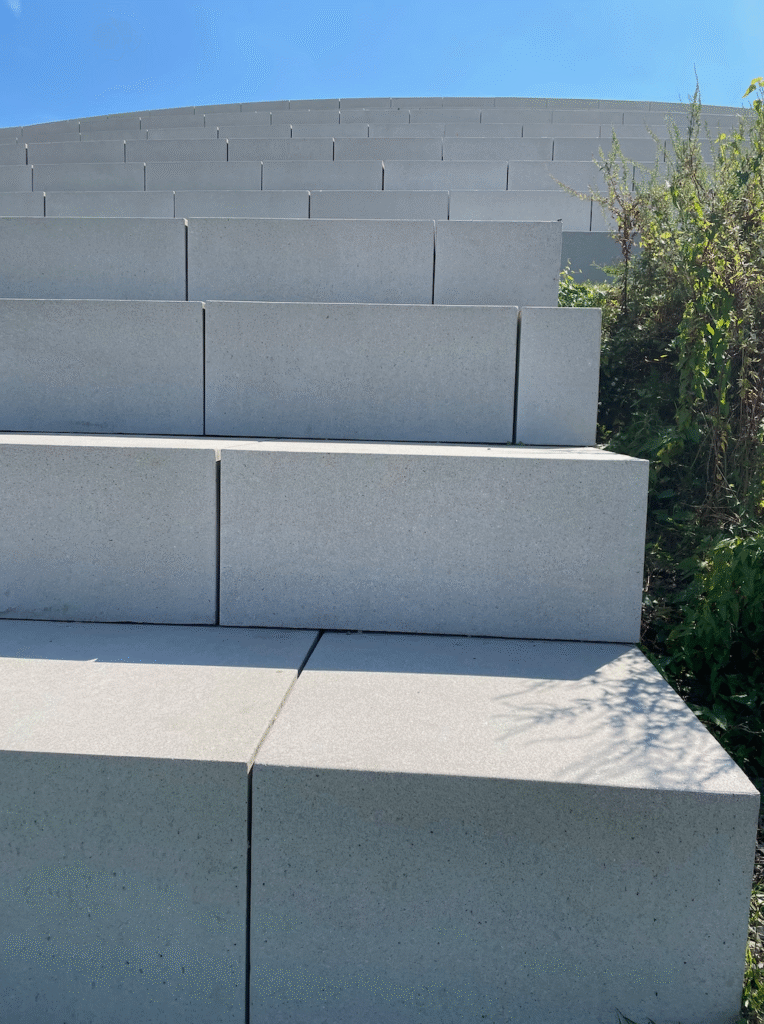
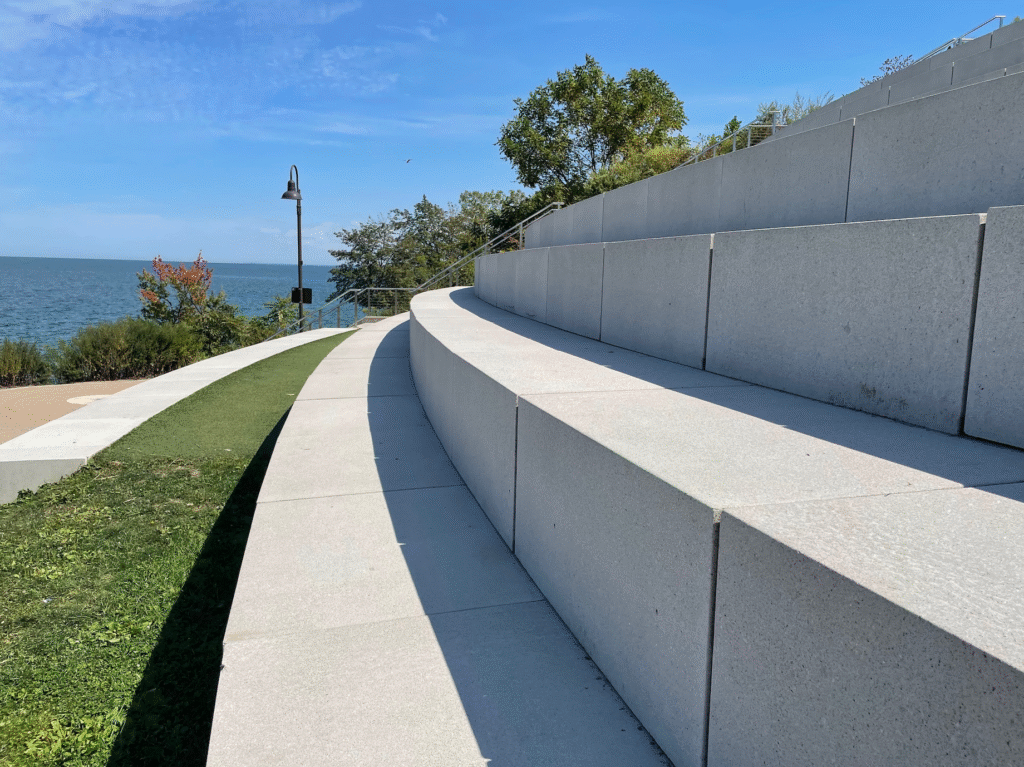
The Solstice Steps are large concrete bleachers on the northwest tip of Lakewood Park angled directly toward the location of the sunset. They replaced an unattractive, foreboding chain link fence about 35 feet above the shoreline and descend a steep bluff. In 2015, they represented a $2 million dollar investment by the city of Lakewood, and the returns on that investment have been multifold.
On any given summer night in Lakewood Park, you will see dozens if not hundreds of sun-worshippers: families excitedly waiting for the magic moment of sunset, couples sharing a romantic moment on the Steps, and singles walking, dogwalking, jogging, or biking along the path below. Yoga groups even gather at the top of the Steps, as if to join mind, body, and spirit with grass, water, and sun in a peak experience of health.
In my case, I have been one of these sun-worshippers since 2017, when my family and I moved back to Lakewood after ten years away. (After living in Lakewood from 2001 to 2007, we moved for a job change but ultimately returned.) In fact, we’ve been so inspired by the bike trails of Lakewood Park that we recently bought a big yellow tandem bike. This “retro” way to reach the park and watch the sun’s show has become one of our favorite activities.
To say that the Solstice Steps were a long time in the making, however, would be an understatement. For as organic as the vision of providing space for locals to enjoy the sunset over the lake seems today, the idea has had a complicated evolution, as a review of Lakewood Park’s history shows.
Established in 1889, Lakewood began as a small frontier town bordering the larger Cleveland. Its main thoroughfares were former trails created by indigenous peoples. Those streets are now called Detroit Avenue (east-west) and Warren Road (north-south), and downtown Lakewood gradually grew from their intersection. The hamlet soon turned into a village and then into a city of about 15,000 by 1911. While Lakewood’s population growth as a “streetcar suburb” before the rise of autos was part of neighboring Cleveland’s industrial might, it also created density problems because Lakewood comprises only five-and-a-half square miles. (Now a city of 50,000, Lakewood has been one of the most densely populated cities between New York and Chicago for decades.)
Fortunately, city leaders in the 1910s had the foresight to seek some land for public use before the rapidly privatizing suburb ran out of space. As Jim and Susan Borchert explain in Lakewood: The First Hundred Years, Lakewood Park was opened along Lake Erie in 1918 after the city purchased 24 acres from the Robert Rhodes estate for $214,500. The Rhodes estate featured a lakefront mansion called “The Hickories” that was built in 1881 and repurposed as Lakewood City Hall from 1920 to 1959.
Remarkably, however, from the 1920s into the 1950s, the shoreline at Lakewood Park featured a city dump! All that growth and construction in the 1920s created a waste problem, and environmental concerns were rare at the time. Fortunately, by the 1950s the city of Lakewood started removing the dump at the park and paying more attention to environmental issues—e.g. breakwall repair and new tree-planting occurred along the shore. As the Borcherts explain, “after years of turning its back on the lake, the city closed its Lakewood Park landfill and effectively landscaped the area to provide both visual and physical access to the lake” (176).
Yes, that is the right metaphor that can be carried from the 50s to today. Far from the “back yard” effect of a distant landfill, today’s Solstice Steps serve as a new “front porch” for Lakewood Park. Now, the entire focus of the park is on the lake, where it should be, after all. The “front porch steps” analogy is especially apt because Lakewood is a city of many beautiful “century homes” built in the 1920s, most of which feature sprawling front porches. Those porches were designed to facilitate neighborliness and community, which is precisely one of the achievements of the Solstice Steps—especially on a summer night at sunset.
Fittingly, however, the actual front entrance to Lakewood Park features an estate wall remnant. At its crown, the remnant is engraved with “The Hickories,” a reminder of the Rhodes lakefront estate that was reinvented as City Hall in 1920 and then razed in 1959. In many ways, Lakewood is a city of remnants along Lake Erie that continually get repurposed.
Today, when I gaze out over Lake Erie at the Steps, it always strikes me that the lake itself is like a permanent remnant of every iteration of life along its banks. And therein may be the key accomplishment of the Solstice Steps: those large bleachers of stone have once again reinvented how the lake factors into our lives.
The new architecture compels visitors to reappreciate the sublimity of nature, especially at dusk. Sitting on the Steps watching the sun do its nightly dance on the horizon creates a communal, liminal experience: sky meets lake, light meets dark, land meets water. No need to cue the viewers’ applause after such a grand experience on a Great Lake—it comes naturally.
Works Cited
Lakewood: The First Hundred Years. By Jim and Susan Borchert. Donning Company: Norfolk, 1989.
Vincent O'Keefe
Vincent O’Keefe is a Cleveland-based writer and former stay-at-home father with a Ph.D. in American literature. His writing has appeared at The New York Times, The Washington Post, Time, Newsweek, Parents, The Plain Dealer, Business Insider, and City Dads, among other venues. Before parenthood, he taught in the English Department at the University of Michigan. He has lived in the Great Lakes area nearly his entire life. He grew up in Niagara Falls, New York, and then lived in Buffalo, Chicago, and Toledo before moving to the Cleveland area in 2001.
Visit him at VincentOKeefe.com or on X @VincentAOKeefe or Facebook at Vincent O’Keefe.