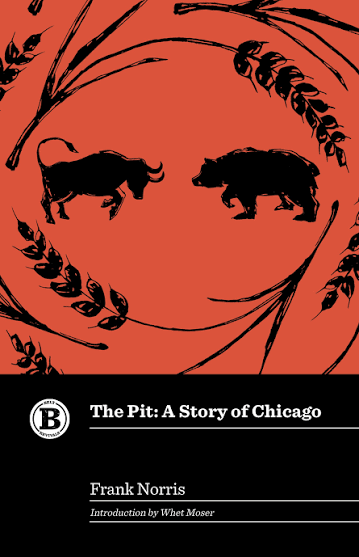
The Pit: A Story of Chicago
Frank Norris
Belt Publishing (Belt Revivals Series)
Many of the great Chicago books revolve around people on the bottom trying to claw their way up from it. These could be Algren’s hustlers or Sinclair’s meatpackers or Farrell’s working poor trying to play it straight. They could be mixed, like in Dreiser. Sometimes, like Sister Carrie or Danny O’Neil, they even make it. Most of the time, though, they are ground up by a system so fat above their station as to seem supernatural. They might be figures of aspiration, and may sometimes be glimpsed, but the rich who churn up the poor are not of the same world.
In Frank Norris’s The Pit (1903, republished as part of the invaluable Belt Revival series), the lives of the powerful are on full display. Virtually no poor people are to be found, nor anyone outside of a household or livery staff who works with their hands. This is neither a corrective nor an antidote to social realism, but a continuation of it. After all, you can’t have the miserable poor without the ones whose lives are transformed by the hard work of others.
This is made explicitly true in the titular Pit. You might think this refers to a factory or maybe some sweaty, rock-strewn immigrant-driven canal project, but it is the opposite: the Pit is the floor of the Chicago Board of Trade, where futures are bought and sold by men whose visions extend across the world but whose horizons end at their wallets.
What are futures? Shortly, and possibly imprecisely (despite a lifetime in Chicago and family who works at the markets, this has always seemed too slippery to me): traders can set a price for, say, wheat in October. If you buy 100 tons of wheat at a price of $100 a ton, you will make money if the actual price in October is $110, and lose it if the price goes down to $90. The farmer, of course, gets the $100 no matter what.
How is this possible? As the Chicago writer and editor Whet Moser explains in his sharp introduction:
“…(g)rain was generally transported by boat and sold in sacks all the way from farmer to end buyer. The train and the grain elevator (invented in Buffalo, New York, and like the Chicago accent, a product of Erie Canal culture) promised faster transport and easier storage of grain, but removing the grain from the sack broke the chain of ownership. The solution was futures contracts: Farmers delivered a given amount of a particular grade of grain at a set price—a price set by the men in the pit.”
What we see is that grain has been transformed from an object that some people grow and sell to others who buy and bake and eat into an abstract tool of capital. But it’s one where people are also transformed into something more resembling capital than humans. A person could get insanely rich one day and lose it all the next. The Pit is a place of convulsive madness, or as a character who may or may not be tragic (and we’ll get to that) imagines it as:
“…some great, some resistless force within the Board of Trade Building that held the tide of the streets within its grip, alternately drawing it in and throwing it forth. Within there, a great whirlpool, a pit of roaring waters spun and thundered, sucking in the life tides of the city, sucking them in as into the mouth of some tremendous cloaca, the maw of some colossal sewer; then vomiting them forth again, spewing them up and out, only to catch them in the return eddy and suck them in afresh.”
Norris describes the system beautifully and poetically, with all its absurdities. Early on in the Pit scenes, a man mentions that he was drinking with a friend of his recently returned from Europe, who told him that there might be some problems between Istanbul and London. Someone tells someone else, and pretty soon everyone is talking about it and what it means for the wheat markets, on the logic that if everyone is talking about it then it must mean something. It is idle gossip turned wildfire that briefly transforms the day before everyone basically forgets about it.
This would seem absurd, but considering how gossip and innuendo and demented posts turn the markets today, we have little room to criticize irrationality.
We’ve been speaking in abstract about characters and the inhuman (and indeed ‘inhumanizing’) force of the market, but one of the more captivating ideas of The Pit is that it is, at its heart, a character study, a romance, a 19th-century drawing room melodrama. Or, as Moser asks in his introduction, “One might wonder: How did I end up in a Jane Austen novel? Certainly, critics and scholars have, to some ill effect on The Pit’s reputation. Austen, whose books are quite concerned with money, might answer: “My most beloved books are about women entering into futures contracts, so to speak.”
The primary character of The Pit is Laura Dearborn, new to Chicago from some grey Protestant town out east. Unlike Sister Carrie, she is instantly in a world of money. An inheritance, rich family friends, a nice place to stay with a sister and an aunt: Laura’s world seems conflict free. Indeed, much of the drama of the first part of the book is if they’ll be late for the opera, awaiting their rich friends.
Laura, who has an artistic temperament, has to decide between three suitors: a real estate investor (already very rich), a common trader (not rich, but getting there), and an artist. Lest you think she has to choose between comfort and taste, the artist is also rich with family money, if a bit of a recognizable scenester (he is described by one of the other suitors as “the kind of man that gets up a reputation for being clever and artistic by running down the very one particular thing that every one likes, and cracking up some book or picture or play that no one has ever heard of.”)
These scenes are extremely well done, and Laura is a wonderful character, filled with contradictions she fully understands. But the reader, looking for scenes of grubbing men trying to get richer on the backs of farmers, could get frustrated with the prolonged dalliances of these frictionless lives, these dramas unaffordable to most of us. But I think what Norris is doing is more interesting than that.
Norris conceived of The Pit as the second book in a trilogy. The first book, The Octopus: A Story of California, was about wheat farmers and their clashes with the railroad companies. The planned third book, The Wolf: A Story of Europe was to be about a famine in Europe, where people depended on the wheat (Norris died, extremely young, before writing it). The Pit takes place between the farmers whose lives and livelihoods depend on wheat prices, and the people for whom starvation hinges on affordable wheat.
So it makes sense, in a gruesome way, to focus entirely on the wealthy. Pulling back, showing the people trampled underneath them, wouldn’t be true. After all, the men doing the trading were concerned with making their fortunes, screwing over rivals, and playing the game in the most thrilling way possible. Wheat wasn’t real, it was an abstraction. Hunger to them wasn’t real. The other two ends of the wheat cycle were irrelevant. It was capital, nothing less and certainly nothing more (nothing could be more). To give these men like these a crisis of consciousness would be forsaking social realism.
There are a few times where their veil is pierced. Laura at one point asks her husband (spoiler: she chose the richest guy) where he put the three million bushels of wheat he bought. “He tried to explain that he had merely bought the right to call for the grain on a certain date, but she could not understand this very clearly.” Nor can I. Nor, I would imagine, could he. Nor can he really explain why he can’t just send the wheat he bought to Europe where people were hungry. He isn’t quite dismissive of his wife — he adores her — but he seems to feel those are the wrong questions to ask, possibly because trying to answer them would force him to face the inhuman artifice of his job.
The drama toward the end of the book involves Laura’s husband getting intoxicated by the wheat market and trying to corner it. Will he succeed? Will he face ruin? Will Laura leave him for the artist?
This, too, is social realism, just at another level of society. Norris shows us a Chicago that isn’t dirty, but shows it as grubby and self-serving and blind to its own machinations as anyone else. It’s the story of Chicago: how do we transform this land, this river, these people, the very wheat we eat, into capital? How do we make a quick buck? Now how do we make a million more?
The Pit seems to know that we’re drawn to stories of wealth even if we despise them. At the book’s opening, as the wealthy file into the grand theater, a crowd gathers outside on a bitterly cold Chicago day.
Yet for all this, a crowd had collected about the awning on the sidewalk, and even upon the opposite side of the street, peeping and peering from behind the broad shoulders of policemen—acrowd of miserables, shivering in rags and tattered comforters, who found, nevertheless, an unexplainable satisfaction in watching this prolonged defile of millionaires.
Every cheap hustler and two-bit conman and dangerous damsel and social climber in every other book about Chicago wants to watch the swells. They want to get out of Algren and become part of Norris’s society. They want to be part of the Chicago story, not at the bottom, but among the ranks of those transformed. They want to dissipate into pure capital. That, Norris seems to be saying, is the true Chicago dream.
Brian O'Neill
Brian O’Neill is a freelance writer living just north of Chicago, along the lake. His focus used to be on international politics, specifically in the Middle East, where he specialized in Yemen. His writing on that topic led him to explore the relationship between the environment, natural history, and current events, a theme which has carried through his work. More recently he’s shifted from the Middle East to the Midwest, with many of the same themes. Brian has written about books for The Chicago Review of Books, The Cleveland Review of Books, Necessary Fiction, Yemen Review, and other publications. Understanding the region, the environment, and the people inside it is his passion and project.