The following is a journal of observations and reflections from a canoe trip through the northern section of Quetico Provincial Park in Ontario. Together with the Boundary Waters of Minnesota, it forms among the largest canoe wilderness areas in the world. My canoe partner and I are 67 years old. We became friends in college and have canoed many times in the Quetico. On this trip, we canoed for seven and a half days, paddling around seventy miles, with around three miles of portages.
July 26. Day 1 evening. McAlpine Lake
We spent last night in Atikokan, a bleak, eerie, former mining town that could be out of the series Twin Peaks. It sits over two hours from any other town. Aptly named Thunder Bay lies two hundred kilometers to the east and Fort Frances on the Rainy River off Rainy Lake falls to the west. There is no restaurant in the town that serves breakfast and few that serve dinner. We first tried The Grill, but a wedding reception brought out much of the town that remains. Went to a second restaurant named The Outdoorsman. It was filled with transient men working on the new pipeline. The waitress sat us down and said, “it will be a long wait.” The men looked us over long with hard eyes. Two men in their early 40s, each over 300 or 400 pounds, sat at their table with empty beer bottles. The larger one said to the other “I can’t get up.”
We left for PJ’s next door, which was empty as it had no liquor license. We ordered a pizza and chicken parmesan with spaghetti that I could not work through. Two young men entered drunk, one large and loud, one thin and quiet. They tried to fill their glasses with hard alcohol. The loud one kept saying, “I’m not paying.” The waitress asked them to leave. They finally rose to leave, but the loud one still argued, raised his voice, and loomed threateningly over her, repeating “you are a mean waitress.” She stood her ground, and they left. Ken asked her what she did in town besides work at the restaurant. She responded, “I walk straight home and back.”
After dinner, we returned to the Quetico Inn where we had checked in earlier. A South Asian family, probably from India, owns the motel. They seem lost, keeping to themselves and satellite TV in this desolation off the two-lane Trans-Canada Highway. After final packing, we slept, woke early, and drove to Canoe Canada outfitter. A man on a kid’s bicycle rode up and down the empty streets and greeted us, screaming, “You think I’m crazy. Fuck you. Fuck you.” We got out of there quickly with our canoe.
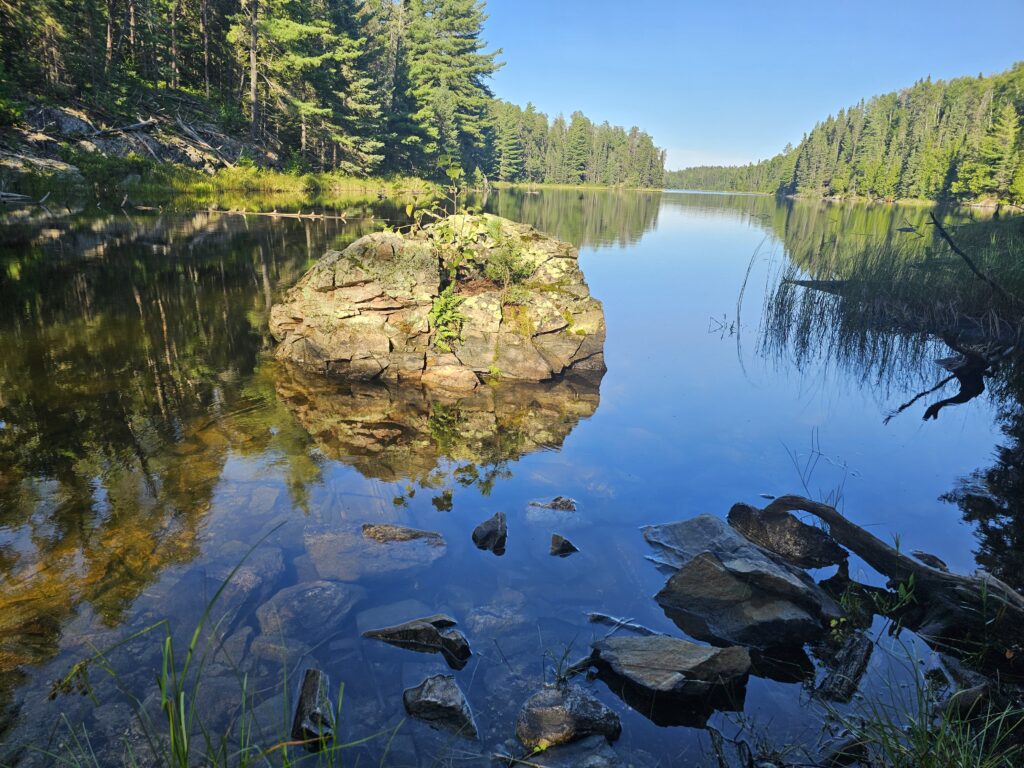
Nym Lake lies outside the park a few miles from town. It is quiet and much less busy than the entry point for Prairie Portage from the Boundary Waters of Minnesota where motorboats zip fishermen and paddlers up and down the long, green channels to the border. We loaded our canoe and paddled south across Nym Lake to a long portage which was, for us, 2.5 kilometers (two trips with the packs, food, and canoe) into Batchewaung Lake. We canoed down the lake, stroke after rhythmic stroke. A wind rose, the sky darkened, and soon thunder and lightning splintered the sky and crashed not far from us. It drenched us for two hours as we stood beside some jack pines on the shore. After the storm, we ate, continued from Little Batchewaung Bay into the fullness of Batchewaung Bay, entered MacAlpine Creek, unloading and reloading through its three portages, to get here on McAlpine Lake.
We arrived at camp around 6.30 p.m., tired after the fourth portage of the day. We put up the tent and did not cook dinner, but rather munched on gorp, a vacuum-sealed salmon, and an energy bar that we split in two. The site is empty but for us, the red squirrels, and the mosquitos that arrived just before dusk. We have entered another world.
Day 2 morning. McAlpine Lake
Low pressure and rain soon to come. Red pines living their vertical life. Calm. Quiet. Deeply, deeply quiet. Time to make breakfast before the storm breaks.
Day 2 afternoon. Kasakokwog Lake
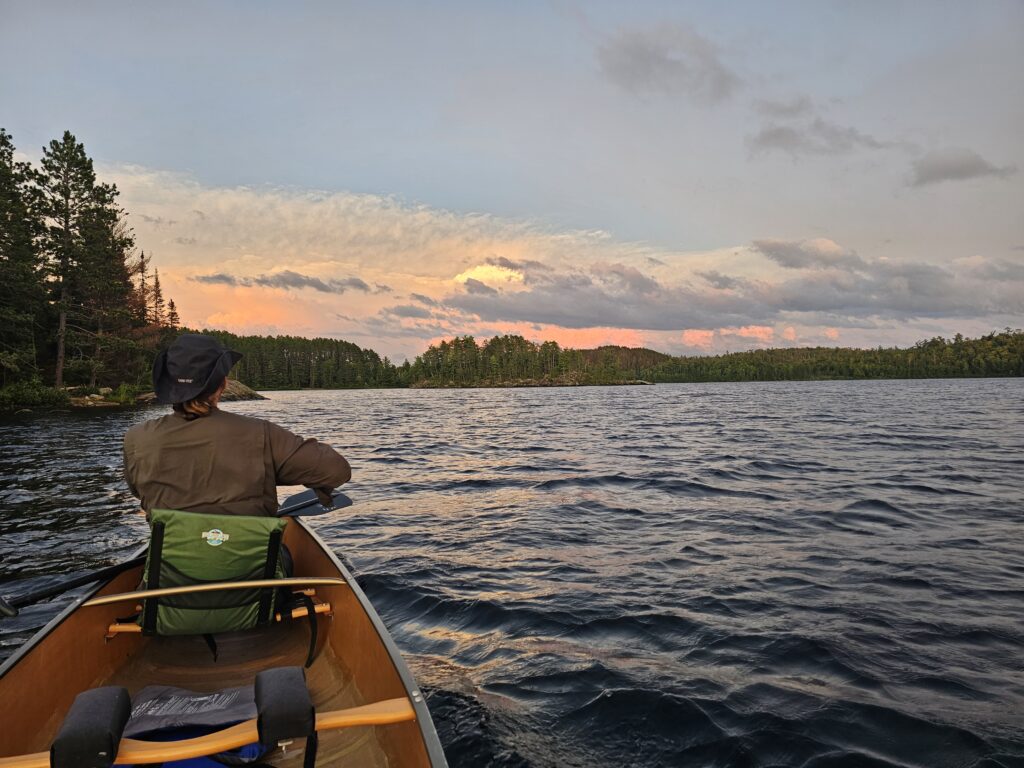
As we ate breakfast, the thunder and lightning crashed, and the rain lashed us. A big wind rose from the east and pushed up white caps that surfed on fast rollers down the length of what had been the unrippled glass of McAlpine Lake. A raucous symphony rose.
We finally were able to leave camp around 9.45 a.m. down the long lake, which again was calm. We entered the easterly extension of McAlpine Creek after a short portage around a beaver dam. It was a sinuous stretch down the creek through the water lilies, first the smaller water shields and arrowroots (known as duck potatoes for the diving ducks) and then the open, fragrant, white water lilies and the tight yellow bullhead lilies. We entered Kasakokwog Lake with another long paddle, my lower left hip and back tightening. We stopped for lunch at a campsite and then decided, tired after two days, why not rest and enjoy the afternoon, which we are now doing over a warm, refreshing green tea. We listen to the lake water splash against the shore. No birds now. Just the wavelets and an occasional breeze through the pine needles and birch leaves. No humans but us to break the soft, percussive rhythm of water on granite shore, wind through tall trees, the trees fed by what has fallen and decomposes around them.
Day 3 morning Kasakokwog Lake
It is a name hard to remember on a white man’s tongue. Surely not named after a girl like Sue or Jean like those that fail to capture the voice of Sue Falls and the contours of Jean Lake. No. Ojibwe names more likely reflect the flight of an animal spirit or the light of a natural phenomenon such as the white caps that surged on the ripped expanse of Kasakokwog Lake last evening. The wind built quickly and made music of the trees and crescendoed into thunder to the west and north of us but passed us by on our small island off an inlet of this lake. We are in the expanse of it now. Kasakokwog again lies leisurely. A breeze ruffles its skin as if with delicate fingers, and the skin dimples in the grinning light from a wafer sun that emerges just now in a gap in the overcast amidst the varied thickenings and loosening of the vaporous gatherings above us. These are the waters we part and enter when we dive into them.
Day 3 evening. Quetico Lake
It was another long day after a long paddle. Three women asked us, mid-trail, as we walked back to get the canoe and bear barrel with our food, first me and then Ken, if we could carry their canoe over the rest of the difficult portage. The husband of one of the women walked ahead portaging their other canoe. I declined, knowing I had ours to carry before me. Ken came behind me, having been photographing mushrooms, and accepted. They were easily three decades younger than us as we now approach seventy.
We had lunch on Quetico Lake and considered calling it a day, but then moved on for just a bit, we had thought, to a campsite around an hour away. No sir. All were taken. We paddled past three groups of pictographs, passed more beautiful campsites that were taken, turned the bend of Quetico Lake to head back toward the east and (fortunately) found a (perhaps last) nice campsite after a seven-hour day. My left thumb was swollen, my left foot slightly swollen, my lower back tight and sore, my right wrist cut from a rock. The night before I had woken from a dull pain in my left hip. We are aging and we feel this trip to these waters could be the last.
Day 4 morning. Quetico Lake
Hazy. Can’t see the expanse of the lake. The sunlight shrouds in smoke, the character of the woods concealed in smoke. Small birds are shadows in the trees. A black-backed woodpecker pecks the living dead. Tell me why we can’t enjoy the lake with full breaths and see the birds sing. The air is better in Beijing. Ken wears a white N-95 mask. The air quality index must be pulsing red. If we could go online, we would receive warnings to “stay inside; it is unhealthy to go out.” But we came here to go out, to be present, not thinking about Donald J. Trump and his “drill baby drill” slogans who Americans elected not once. But twice! And here we sit on granite stone, peaceful, but for the cancer we breathe in a world on fire.
Day 4 afternoon. Quetico Lake, southeast end
Once more we paddled the southern length of Quetico Lake, having canoed the northern length yesterday. We paddled three hours today after a more leisurely morning, had lunch, swam, lay prone and enwrapped in a nap, and now savor this moment with sips of green tea.
The lake is calm again. The air quality number must be a tad lower as we can see the definition of trees across the lake. The black-backed woodpecker is more visible; its red blush of a patch on its throat briefly displays. How the light shimmers now on the wind-ruffled water in this ever-changing mix of air, water, and light. Some patches of water are still as glass, as if in deep meditative calm, while others animate with rippling light as if eager to express themselves. We sit above the waters on a patch of green clover with their small, intricate, white fireworks of flowers bursting from thin stalks.
***
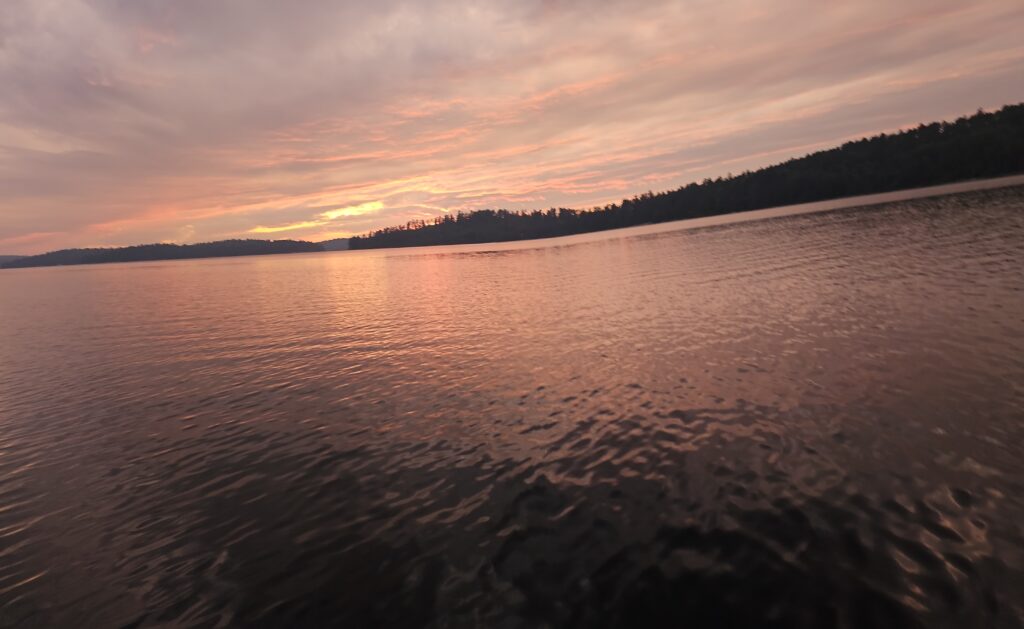
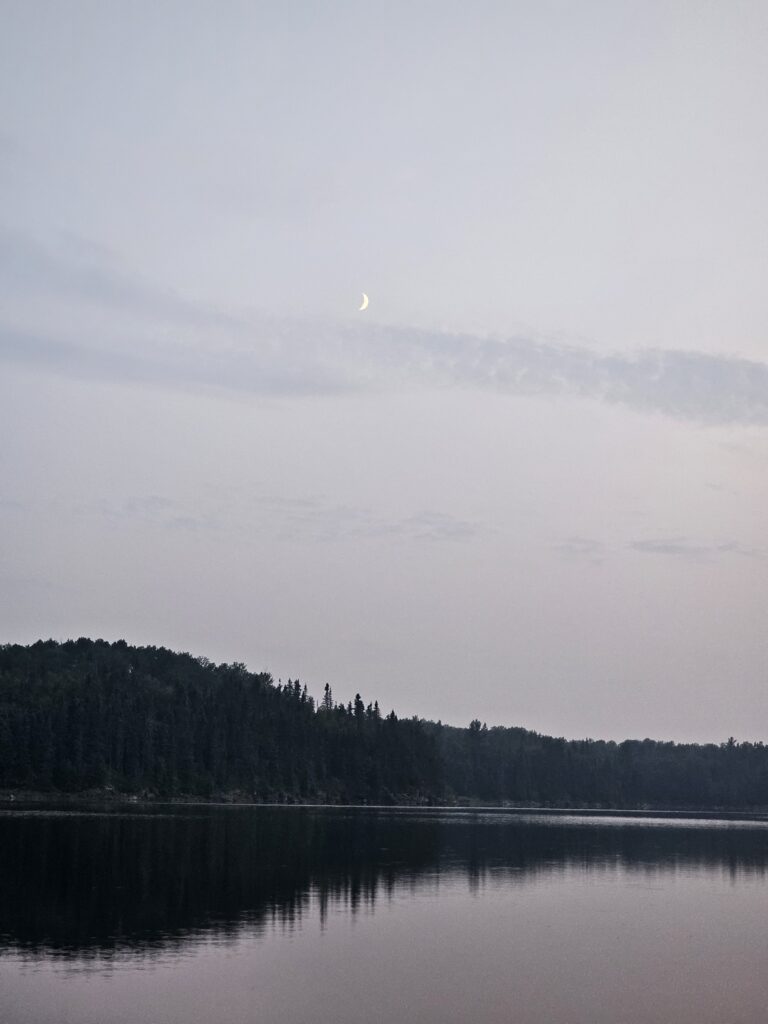
We take our evening paddle beneath the waxing crescent of the moon. We float by a rock cliff on the water. The green moss on the rock’s lower reaches reflects below, mirrored as an underwater garden. We sit silently in the canoe and listen to the occasional yellowthroat call. A loon’s high pitched eerie song of deep wisdom reverberates. An energy pulses as if the world is an interconnected vibration and we are part of the rippling waves of it, our bodies and minds merging within one pulsating, interwoven anima.
Day 5 morning. Quetico Lake
Cool morning. Mist slowly flows west off the lake, creeping along the surface like the ghosts of those who came before us and our memories of our lives. This life has come to here now, the cool air against the warmer water making mist that sifts and unravels westward down the lake’s length, which thins as the sun rises, and is lovely, before it’s gone.
The mist brings back our past on these lakes, younger on July mornings, as the sun rises bright and warms my fingers once more as they write down these words passing with the bird chirpings in the morning air.
It’s like this. We sit in these calm, tranquil mornings, watching a loon dip in and out of the glass water, hearing the birds chirp and trill against a small stream’s waterfalling, the small birds singing as the sun rises and casts light along the water. We sit on striated granite stone beneath the white pines whose needles glisten as if pulsing. And later we walk muddy and stony paths on portages and paddle to another site before entering a tent encircled by the evening’s serenade of mosquitos. Pleasures and pain, ease and hardships, accepted, become one.
Day 5 evening. Hamburg Lake in the tent
After a leisurely morning, we paddled to a portage, hiked our gear, reloaded, and stroked into Oriana Lake. At the far end, as I moved quickly to stabilize my backpack from falling down a slope into the water, something stung the top of my right hand. The sting continued to hurt so that I knew it was more than a bee. We canoed down Oriana Lake and my hand began to swell. My right fingers were already feeling arthritic, and the sting further swelled them. We wonder if it was a hornet. Ken wondered if it was an Asian giant hornet.
We then had to paddle up the current of a stream in a sinuous route through long, marsh grasses to get to Hamburg Lake. We shoved the canoe past beaver dams. I slipped to my hip in the water as the water’s depth thinned and deepened in the narrow passage through the grasses. When we arrived at the lake, we checked our feet and they were smitten by black leeches, some large and others just tiny specks that must have been babies. Ken removed each leech with tweezers as our feet bled. We reloaded the canoe, and I could not grip the paddle with the fingers of my swollen right hand. I sought to paddle without a grip.
Day 6 morning. Hamburg Lake
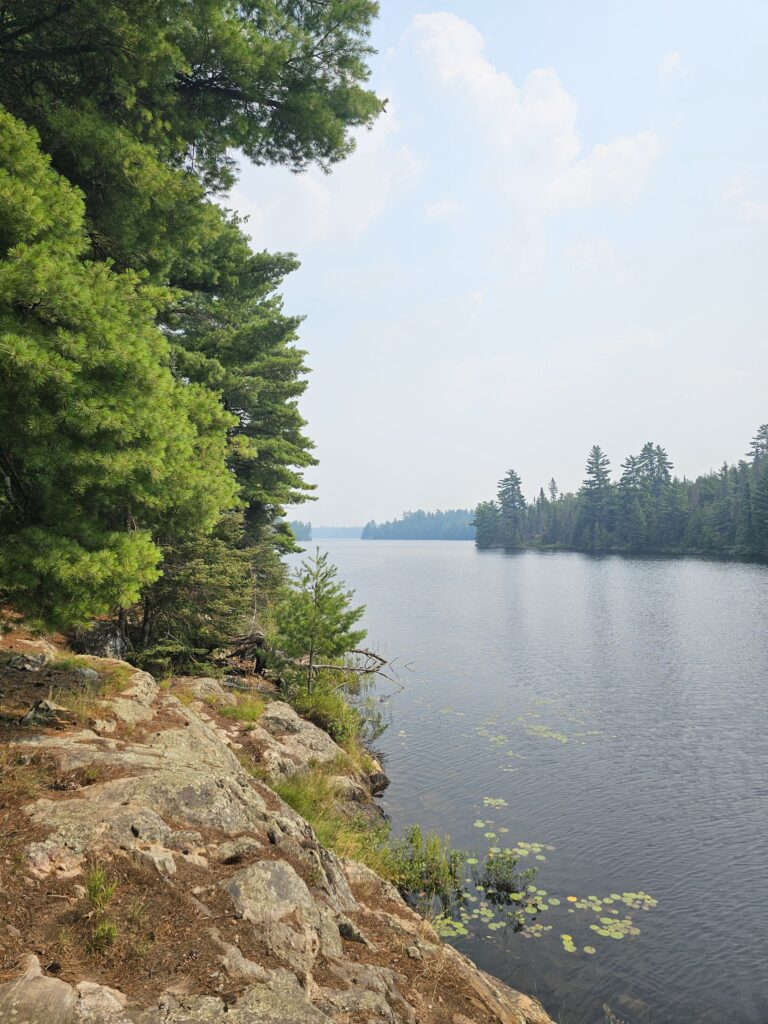
It is a smoke-blurred dawn. An orange sun turns yellow as it rises through the haze. In the cool morning, I wear my hat and fleece for the first time, as well as an N-95 mask. Mosquitos search for my flesh. My welts itch from my neck just beneath my earlobes to my ankles. A lone blue-winged teal makes a parabolic wake that ruffles the water, flaps its wings, and departs. No trace remains. My hand still swells from the hornet’s sting, the sting still itching as if it is still penetrating my hand. My right hand has ballooned like a single swollen welt. I observe it. What would life be without a grip? Like a fallen tree on the forest floor letting go. The rising sun bleeds light through the smog like a blush of shame.
We speak of our youth. Ken recalls his mother’s remark on the phone when he told her he invited a black college friend, to the house for a holiday. “You know those black girls just want sex,” she said. Ken was shocked by the hatred that had accumulated in her voice, suddenly released. His mother was so sweet to me in my younger years. I still hope for this world, with its contradictions and hypocrisies, its depredations and resilience, balancing (to take from Gramsci) a pessimism of the intellect with an optimism of the will.
Day 6 afternoon. Maria Lake
We loaded and unloaded for three short portages up the creek from Hamburg Lake to Maria Lake. We arrived for lunch, swam, ate, and napped. Now we drink green tea and relax. A lovely day but for the smog. We wore masks through much of it. I took off mine from time to time for ease of breath, though what will it mean for my future breath is the question. Ken’s nose is marked red from the metal pinch where he wore his mask more consistently.
When we arrived at this campsite, we startled a brood of mergansers from the bank. They shat white liquid on the shore and water while entering from the rock beside which we landed. Over twenty ducklings followed the mother hen. They likely included another mother’s offspring from “egg bombing,” where a mother leaves her eggs for another hen to warm and raise. I sit beneath white pines. The camp site is bedded by dry, red needles where fallen cones provide a field day for the red squirrels.
Day 7 morning. Maria Lake
Red sun rises, its color intensified by the smoke from the distant fires to the north and west. It rises through bars of red and white pines as I sit in early August of the year 2025. The fires burn as a U.S. petrol-worshiping administration lays the kindling for future burning. Mr. Trump, befitting the Mafioso Don of his christening, aims to bring back imperialism and white supremacy and make them great again. He is fervently cheered by his followers and hated by others. An atmosphere of fear thickens.
There is less mist off the lake this morning in a third day of cooler weather. My right hand is still swollen and itchy. My right fingers are still swollen and weak and achy. It could be a big day before us, a long portage followed by miles of paddling.
I reflect on the beauty of these years coming here with Ken. We are aging and slowing down. We walk the portages more slowly and more carefully. We know the cost of a slip or tweak could be greater. We are here for a shorter time, which makes the food-load less and that is better for the legs and back. Given our age and this smoke, this could be our last trip to these holy waters. We feel a greater tiredness, but the same appreciation for them. I reflect on all these years listening to the quiet in the quietude, entering and feeling part of this larger world. The water reflects the evergreen trees and the length of our lives along these lush, green banks. Our youth and coming of age and now gazing back on it are all lit by the rising and falling sun that provides glimmerings of our past mixed with a soft breeze on the waters. The water striders zap like electrons in the interconnected lives of water, land, and air, creek and lake, red squirrel and red pine, unknown birds and known ones, all our brothers and sisters making intermittent songs, ancient and new, in this ever re-beginning world. Last night we saw our first beaver of this trip, swimming with its nose up, seeing us, smacking its paddle hard on the water, diving under our boat, waiting for our departure. A loon calls. Another responds. They create lingering echoes across the expansive waters.
Day 7 evening. Batchewaung Lake
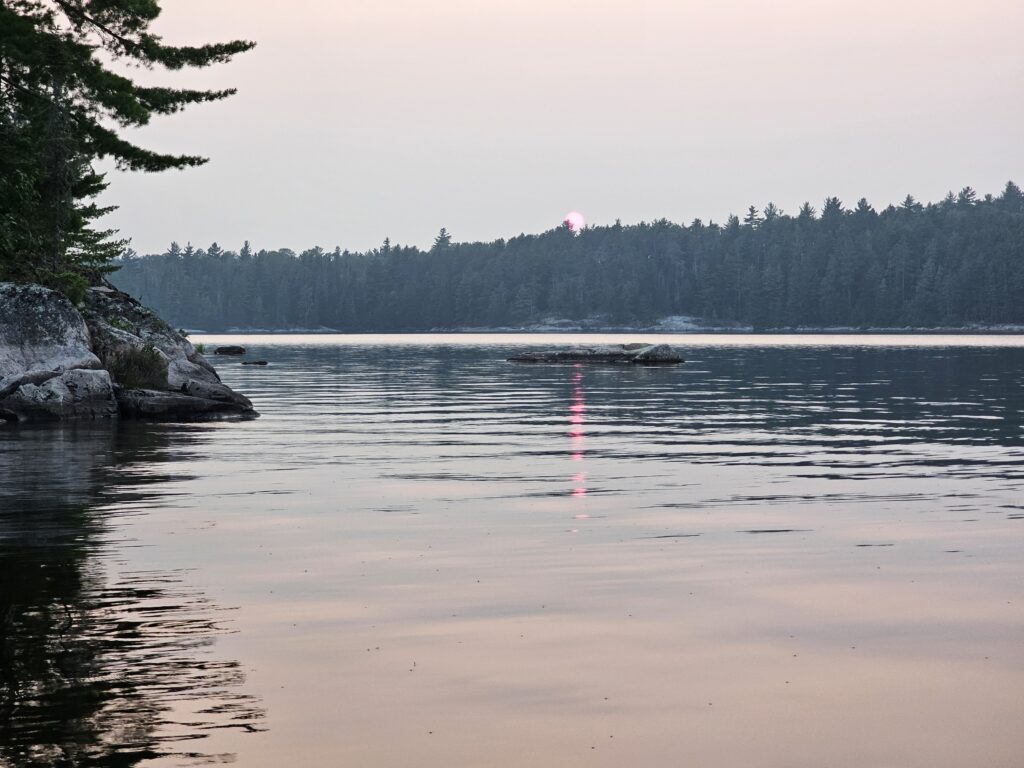
We left Maria Lake at 9.15 a.m., paddled to the portage, carried our belongings, reloaded into the southwest bay of Pickerel Narrows, and canoed back up Batchewaung Bay and north across its large lake. We found this campsite, our last one this trip, of pink granite above low, flat, water-sculpted stone, Henry Moore-like, beside water pools, balanced perfectly like yin and yang, with minnows swimming in the pools. We took our refreshing swim, ate lunch, and now sip our last afternoon green tea of this trip. In the pool, one-eyed white flowers, called pipewort, on thin, leafless stalks, rise like a colony of aliens. The wind seems to have shifted. It now comes from the southwest and will likely bring less smoke as we prepare to leave. We have canoed around seventy miles on this trip and walked another nine through the portages.
Day 8 morning. Batchewaung Lake
Last night on our evening paddle, we came upon a baby eagle crying for food from its nest atop a tree on an island on Batchewaung Lake. I had thought it was mergansers warning of the mother eagle we saw alight from a nearby branch. The baby eagle soon quieted, chomping on the flesh and guts of a large fish its mother left. Loons called and flew across the lake’s expanse. Last night, for the first time on this trip, we heard human voices carried across the water from another campsite. We are about to return to a human-dominated world.
Ken had not screwed his water bottle properly last night, and I woke to wet feet in my sleeping bag. I propped them on a pack in the dark, thinking it was dew. We woke at 6 a.m., thirty minutes later than intended, which I realized when my watch beeped for the hour in the morning light. In the dark of the night, I had turned off the alarm instead of the obnoxious, hourly beep that I had mistakenly set and had woken me. Planning, mishaps, and adjustments – all part of the journey.
Two sandpipers visit the little granite cove with its inlets and pools. They wag their white, flashing tails up and down like anxious teenagers flirting. A loon drifts past, dives, and paddles on. The waters murmur against the shore. May we carry their steady, easeful sound in our heartbeats and breaths through the rest of our days.
Gregory Shaffer
Gregory Shaffer is the Scott K. Ginsburg Professor of International Law at Georgetown
University and immediate past President of the American Society of International Law. He has
published poems in a dozen journals and a chapbook of poems entitled Forest. He has published
twelve books of non-fiction.
You can find Gregory here: https://www.law.georgetown.edu/faculty/gregory-shaffer/ and
https://www.gregshaffer.com/