The first paragraph placed me on a shoreline. The second put me on a city street. A few minutes later I was standing in a grove of trees, then beside a harbor, then on a road somewhere I had never been.
After my essay was accepted for publication in Great Lakes Review, I spent an evening exploring the journal’s website. Eventually I found my way to the Narrative Map archive. One story led to another. I followed writers into places I knew and places I had never seen, moving through the region one opening paragraph at a time. Somewhere in that process, I began wondering what those essays might look like gathered together geographically.
To begin, I read the opening paragraph of all the Narrative Map essays, looking for the clues that would tell me where each story belonged. Some writers named the place immediately. Others arrived there more slowly, through a landmark, a stretch of water, a neighborhood, or a curve in the road. A first paragraph often tells a reader where they are. Reading eighty-six of them in succession revealed how many different ways there are to locate a person in the world.
After a while, the openings began to blur together. Not because they were similar, but because they were all trying to do something familiar: place us somewhere. Each writer was establishing a relationship between memory and landscape. A shoreline was never just a shoreline. A city street was never just a city street. Place carried family history, loss, wonder, belonging. The geography mattered because of what had happened there.
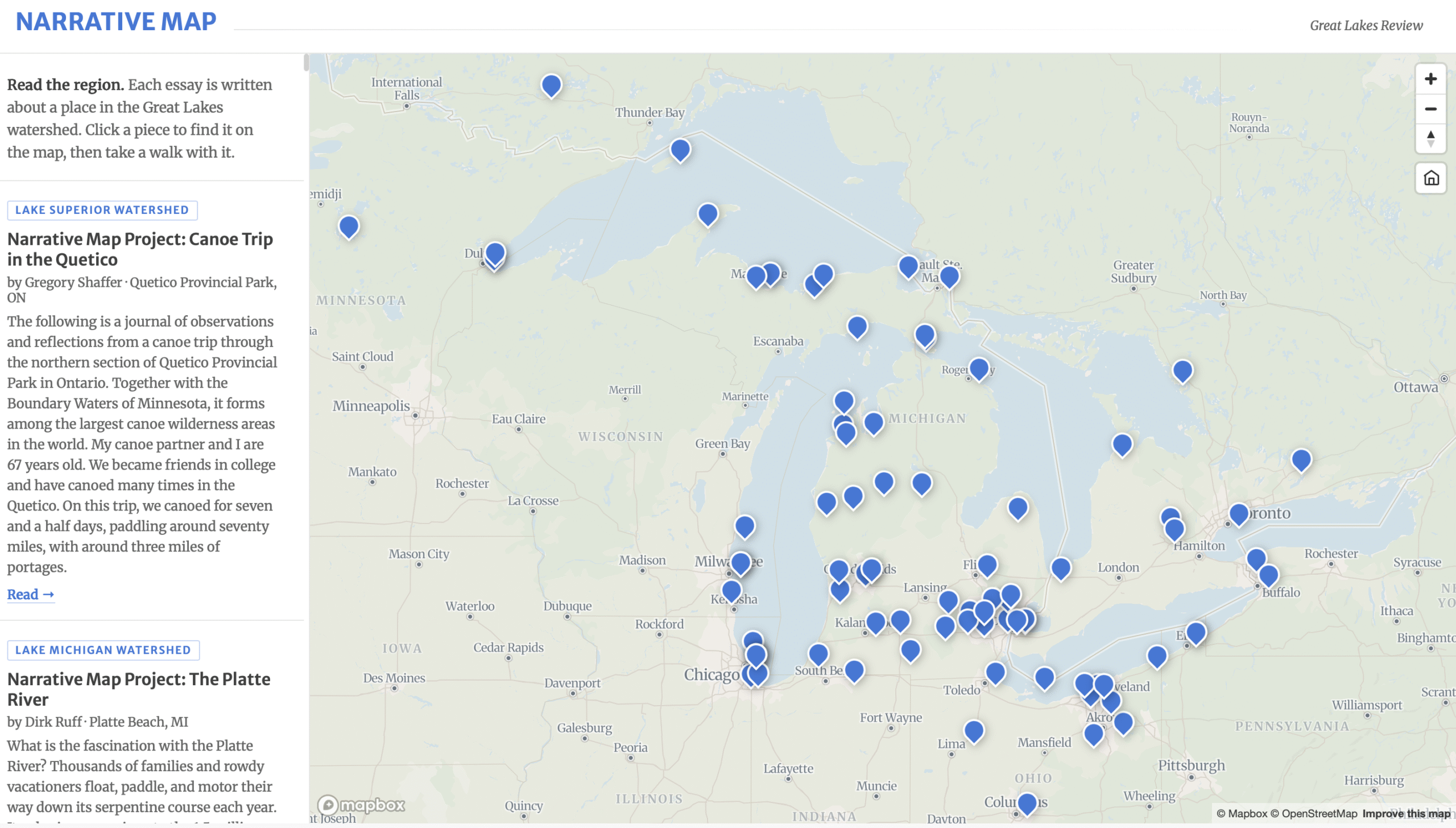
Turning those places into a map took several months of quieter work. I designed the map from the ground up so it would feel like the region it holds: soft water, pale shorelines, and lettering set in the same typefaces readers see on the journal’s own pages. Each essay became a marker, and each marker opens onto its first paragraph and a path back to the full piece. Alongside the map runs a list of every essay, so a reader can wander by place or by story. The last piece was making sure the map could keep growing long after I stepped away. The journal now has a simple form to use when adding each new essay, asking for its title, its author, where it is set, and how it begins. Once an entry is submitted, the new story takes its place on the map for the next reader who comes looking.
Looking back as the map filled in, I found myself thinking less about coordinates and more about attention. The Great Lakes region emerged not as a collection of boundaries and shorelines but as a collection of people looking carefully at the places that shaped them. The essays moved from Minnesota to New York and from Ohio up into Ontario without pausing at a single border. The region does not belong to one state, one province, or one country; it is shared across all of them. Every marker began as a first paragraph, a writer locating themselves in the world. We can meet them there, as if we were there too.
Seth Frame
Seth Frame's work has appeared in Blood+Honey and The Argyle. He grew up in South Bend, Indiana, and his creative nonfiction explores themes of place, memory, and connection. He now lives in Schenectady, New York, with his two sons.