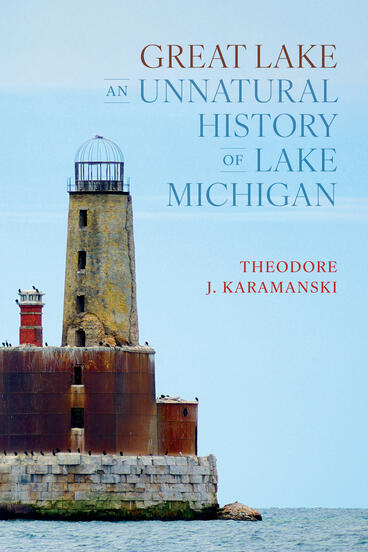
Great Lake: An Unnatural History of Lake Michigan
Theodore J. Karamanski
University of Michigan Press
A boulder, a huge chunk of rock broken down from mountains over millions of years, finds itself pushed south by a massive, continent-warping glacier. It is broken up under the unimaginable weight, dispersed into countless smaller rocks, one of which ends up on the beach of a vast lake carved and filled by the same glacial forces. One hot summer day in 1919 one of those rocks was picked up by the hands of a man and hurled at a young Black boy who drifted into a whites-only section of Lake Michigan. The boy drowns, sparking a blistering burst of racial violence, killing dozens.
There is nothing teleological about history, much less geology. The rock wasn’t fated to be a dull tool of white supremacy. It just happened to litter a Chicago beach during a time of segregation, economic unrest, and simmering reactionary hatred toward the Great Migration. It was just there on a summer day.
But why it was there — why that beach was rocky, why that beach existed at all, why Chicago and other Lake Michigan cities were formed the way they were — is part of the story of Theodore J. Karamanski’s Great Lake: An Unnatural History of Lake Michigan. Karamanski explores the interaction between people and the lake, and how we shape and distort this vast and uniquely American sea.
Karamanski, a Professor Emeritus at Loyola University in Chicago (whose campus is buffeted by Lake Michigan) only spends a brief time getting into the geological origins of the lake, but any time spent thinking about the immensity of the glacial flow and the mind-blowing coolness of ongoing isostatic rebound is valuable and thrilling. He details what life would have been like for the Native people, who were around when the ice retreated (making man not an invasive species, though Karamanski deftly complicates that idea later on, as we’ll see).
Karamanski certainly doesn’t portray Natives as noble savages, though there is a reason 90% of the book is during the colonial period (still ongoing): we’re learning about the ways humans altered Lake Michigan, and most of that was done after European intrusion.
Great Lake is broken up into chapters largely based around technology in specific time periods, like “Canoe” and “Sails” and “Steam.” These are of course not neatly distinct periods, and they overlap, but it is a smart way to discuss the ability to change the lake. Canoes, favored by the local native tribes and nations, are easy to maneuver and fast but can’t carry very much. Early trappers and missionaries and settlers used canoes until the advent of sailships in the Lakes. This makes for an early and disquieting image when Odawa Ogemuk (chiefs) see a sailing ship enter the waters of Michilimackinac. They had seen ships when canoeing to trade with the French up the St. Lawrence river, but
“…never before had such a vessel come to their home waters. The ship was the Le Griffon, built earlier that summer by the merchant-adventurer Rene-Robert Cavelier, Sieur de LaSalle. The modest vessel was described as being capable of hauling 45 tons of cargo and was likely between thirty and forty feet in length. This made Le Griffon small by ship standards, yet she stood tall among the more than 100 canoes that darted curiously around her anchorage. The ship was an important harbinger of what was to come. That notion was not lost on the Ogemuck.”
The notion that the ship meant change, bad changes, was coming was reinforced by the cannons on the ship. And while the Le Griffon didn’t make an immediate impact — it disappeared on a return journey, rumored to be sunk by the Odawa who correctly worried about it disrupting their trade routes — the age of sail had begun on the Lakes. Being able to shrink the time it took to get from Point A to Point B made trade faster and increased the power of those who had the ships. Sail changed the relationship of people to the lake in a way that favored European conquest.
If sails changed the nature of the relationship, the advent of steam ruptured it. The first steamship, Walk-in-the-Water, made it to Lake Michigan in 1820. Karamanski quotes a journalist saying that steam was the “annihilation of time and space,” a very 19th-century ‘boosterishly’ cheerful way of promoting an apocalypse. Or, as Karamanski puts it:
“That happy phrase captured Americans’ wonder at the new world wrought by steam: a communication revolution that brought about a North American metamorphosis. Before steam, the fastest way a person could move across the land was by horse — a Stone Age innovation. Walk-in-the-Water was the first steamboat on the upper lakes, yet in twenty years the inland seas would be crisscrossed by a hundred wood-burning, smoke-belching wonders while iron horses raced over prairies and through virgin forests.”
Of course, those forests would not be virgin for very long. The growing American nation demanded lumber, and the vast forests along the lake, especially on the Wisconsin side, seemed inexhaustible. They weren’t, of course, and proper forest management wasn’t exactly a natural result of capitalism. The forests were whittled away, and their byproducts turned to buildings or to sawdust.
(One happy byproduct of the lumber trade was an influx of immigrants to the area, whose cultures exist in some form throughout the region. One only need get breakfast at Al Johnson’s in Door County to remember, for example, that Swedish power was partly responsible for American growth. This is true of every immigrant community, then and now).
Sawdust is more important than you might think. It had to go somewhere. Sometimes it was left in vast piles to ignite in fires like the one that destroyed Peshtigo and killed some 2500 people on the same day of the Great Chicago Fire. Other times it was “safely” dumped into wetlands or rivers. This might not have the same deadly and immediate horror of fire, but thousands of tons of sawdust killed off species, choked off vital wetlands, altered rivers, and changed the nature of the lake.
Indeed, if there is a theme that runs through the book it would have to be “byproduct.” We build. We grow. But nothing is created out of wholecloth, and every product has waste. In every chapter, through “Steam” and “Steel” and most humanly in “Sewers,” people have to figure out how to handle the waste made by our gigantic presence. Factories dump effluvia into the rivers and lake; industrialists displace dunes to create giant foundries; the sewage of Chicago and Milwaukee and a hundred smaller cities has to go somewhere. Ecosystems are altered and destroyed and poisoned.
Sometimes, bizarrely, these alterations are productive. Karamanski talks about Chicago needing a harbor, and finally building one in 1838. Its high walls blocked the waves, but there was an unintended consequence. Waves carry sand from across the region, heading south. The walls blocked the transfer, “such was the volume of sand flowing in upon the waves that acres of new land were created north of the Chicago River from the accumulation of sand partially blocked by harbor piers.”
You might think, ok, so there was some sandy land, no big deal. This is the land now known as Streeterville (after a wily old captain who claimed it as his own). The Magnificent Mile, the John Hancock Building, the Drake Hotel, and other iconic parts of Chicago rest on that sand, frustrated by a dinky 19th-century harbor. Such is the weight of the lake and its forces, and such is our ability to alter it.
That is one of the more sobering aspects of Great Lake. The lake is immense, and we have immense capability to change or ruin it. Everything impacts everything else. Sand taken from dunes in Indiana to build factories is transferred to Northwestern University, which builds acres into the lake. Not only is the ecosystem of the dunes ruined, but this unnatural protrusion also keeps sand from flowing south, helping to create destructive erosion to the south. I have sat many times on that piece of land, thinking that I am so close to nature, breathing in the lake, but there is nothing natural about my being there.
Karamanski hammers this home in the chapter titled “Invasive Species.” While most of the chapter is about the exotic animals — the lamprey, the quagga mussel, the alewife — the blame for bringing them is people. Or more specifically, while humans aren’t an invasive species, having lived here as long as the lake has existed, “exotic species entered the lake because of a separate human population that is itself a recent and invasive presence. This population — European Americans — in a few hundred years brought revolutionary change to the lake’s endemic human and animal populations.”
“It is hard,” he writes, “to overestimate the degree to which Lake Michigan has been transformed over the course of the last hundred years…Across the 22,000 miles of the basin, a vast unplanned biological experiment has taken place — engineered not by some mad scientist with a purpose but rather by an unwitting, unthinking, even whimsical disregard for consequence by a society committed to the otherwise admirable principle of individualism.”
But don’t despair: there are obviously green shoots, and Lake Michigan has rebounded from its most polluted days. People now see the lake both for its own intrinsic and inhuman nature and for the joy and peace and happiness it can bring us. Karamanski closes the book with some of his favorite spots along Lake Michigan, lighthouses and piers and other places to feel its bright and furious beauty.
It’s funny, though: those are all manmade or man-altered points. But then, I don’t know if I have ever stood at a point of Lake Michigan that wasn’t altered, that was somehow pristine. And in a way that’s ok. We can impact the lake without destroying it. We can understand the consequences of our actions and look to the future instead of just the insatiable now. We can transform this wild lake, but should also allow ourselves to be transformed. If we do, if we have respect for its power and fragility, its patterns and needs, its demands and rhythms, then even our unnatural encounters can be sublime.
Brian O'Neill
Brian O’Neill is a freelance writer living just north of Chicago, along the lake. His focus used to be on international politics, specifically in the Middle East, where he specialized in Yemen. His writing on that topic led him to explore the relationship between the environment, natural history, and current events, a theme which has carried through his work. More recently he’s shifted from the Middle East to the Midwest, with many of the same themes. Brian has written about books for The Chicago Review of Books, The Cleveland Review of Books, Necessary Fiction, Yemen Review, and other publications. Understanding the region, the environment, and the people inside it is his passion and project.