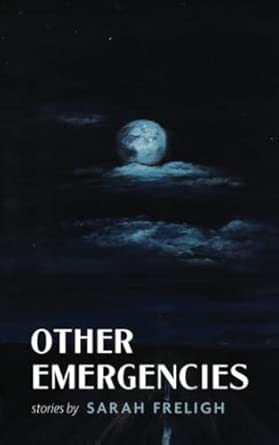
This collection follows the hardscrabble lives of the working class and working poor as they lumber through the bleak, unending grit and wet gray ash of their lives. Even though some rise above their station, as Shelby manages to in “As Beauty Does,” a life started in the ways and means proffered in the world of Other Emergencies is never truly transcended. Even Shelby, a Pulitzer Prize winning playwright, is known by name only, the real her relegated to the manufactured blind spots of American immorality. As it is in United States, so it is in Other Emergencies.
In a manner true to the population she depicts, Freligh’s characters do not invoke pity or sympathy. The stories are not a clarion call for social action or reform. Instead, the characters shoulder their realities and share them as if nobody has ever truly listened and never will. Characters share their stories as if most of what is revealed is a tired repetition that proceeded even their lives. Their struggles are regional, cultural, social, and structural. Characters in this collection relay struggles with addiction and self-acceptance as if recounting a ball game with their neighbors. They find kinship where they can, drugs and alcohol, of course, but also in survivors of domestic violence, feral cats, other’s spouses, and the taking of human life. It’s a collection where the “nice people” are not remembered (129), likely because they were never present, at least not in the lives of those populating Other Emergencies. Aptly named, the collection unfolds to a backdrop of emergencies as large as school shootings and bank robberies and as trite but influential as parental unkindness, emergencies brought on by poor decisions and circumstances outside characters’ control. The message here is that there will always be another emergency for those in this collection and for those in the real world who they represent.
Because there are other reviews out there that synopsize most or all of the stories in Other Emergencies, I want to highlight two that showcase the breadth at which Freligh writes. The first, especially clever and rife with interpretive latitude, is “Other Tongues,” a piece of flash fiction told in first person by an ungendered, unnamed narrator. The premise is that the narrator’s brother was killed and the narrator is unable to verbalize the effect it has. After a therapist identifies the narrator is struggling with repression, the narrator believes it might be possible to articulate the loss in another language and so pursues French classes, which are taught in a grade school, alongside a Spanish class. Most of those enrolled in the French class stop attending. Then, one night, the French teacher dies. Despite Googling, the narrator is unable to learn more and so fills the unknown with tales of murder that the narrator shares with a stray cat over breakfast. The narrator continues learning French on their own but only gravitating towards words relevant to their life such as “gun . . . six-pack of beer . . . holdup . . . senseless” (5). The incommunicable nature of death is delicately rendered in this story. There is something universal in the failure of words to encapsulate an occurrence as profound and permanent as death. To this many of us can relate, I’m sure. However, that same experience through the life of the narrator becomes uncanny, both alien and yet somehow eerily familiar.
Freligh, known for her surgical precision in flash and micro fiction, also demonstrates in this collection her aptitude at more traditional lengths, most apparent in the stories “Heaven” and “Serendipity.” “Heaven” is told from multiple perspectives and centers on a murder at a burger joint. The characters in this story are unmoored in their own ways and, whether aware of it or not, are on a kind of pilgrimage to discover themselves. Not unlike other characters in the collection, or people like them in the real world, this pilgrimage involves an attempt to understand, wrestle, and come to terms with the relevance of violence and struggle within their lives. What role do they play in it, and what effect does it have on them? This reconciliation of oneself through violence is also present in “Serendipity,” where women are survivors of domestic violence, and men, despite their efforts (and sometimes lack thereof), cannot seem to break that cycle. Even Syl, the narrator who’s attempting to recalibrate after re-entry to civilian life after being released from prison, found hope in a future when behind bars but struggles to when on the outside (140). “Serendipity” only begins to touch on the themes of domestic violence, reintegration, drug and alcohol addiction, and the lived experience of a mother estranged from her daughter. When finishing “Serendipity,” I wished it had been a novel. I wanted to drown alongside the characters in the depth the story possesses but that, for now, remains un-inked.
Finally, I’ll part with this. What allures me most in Other Emergencies are the women. Freligh writes women in a way that makes me feel I’ve never quite known them, no matter their relationship or proximity to me. Yet in them, I see the matriarchs of my life. There is a nuance and a deafening silence to how women in this collection both handle and sometimes create the struggles in their lives. Their challenges and miseries, which could’ve been rendered loudly, are but a susurrate, a miming of, at times, staggering tragedy that, for me, was like witnessing the lives of those in my neighborhood, my people. The creative gymnastics necessary to balance such dissonance in harmony is no small feat, and Other Emergencies is no inconsequential book of stories.