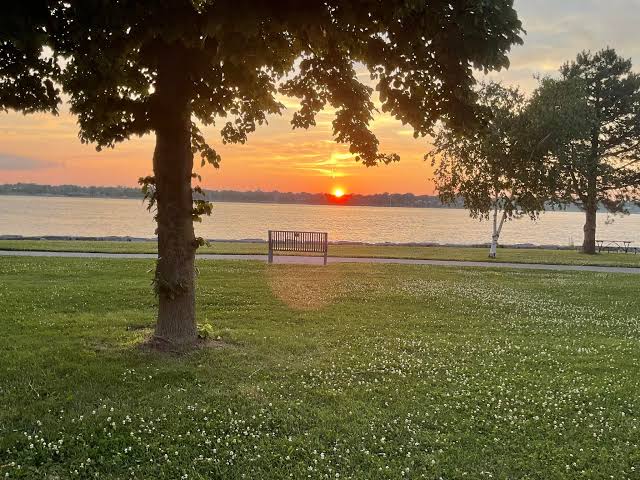
I grew up in Courtright, Ontario, where the United States is not south. It is across.
St. Clair, Michigan, sits on the other bank of the St. Clair River. The water between us is wide enough to carry lake freighters and narrow enough that the other country never becomes an abstraction. You can see its shoreline. You can watch its weather move. At night, its lights keep their place across the dark water like a second set of constellations, lower and more practical.
The maps call the river an international boundary. They are not wrong. Somewhere in the current, Canada ends and the United States begins. But the line has no fence, no paint, no natural authority. It is a legal fact carried by water that refuses to hold still.
That was my first education in government: the state can draw a line through a living system, but the system does not become two systems because the ink says so.
The river carries both countries at once. Water, industry, weather, fish, pollution, ships, memory and family do not stop in the middle. A vessel moving south from Lake Huron does not become a different ship at the border. A storm does not clear customs. Neither does smoke. The river teaches jurisdiction every day, but it also teaches the limits of jurisdiction.
I am a Canadian. I am not uncertain about that. My pride in Canada was formed on the edge of it, where patriotism could not depend on pretending the country was self-contained. Canada was real because it had a shore, a flag, a law, a way of speaking and a way of doing things. The United States was also real, close enough to be familiar and different enough to sharpen the distinction.
Border people learn comparison before ideology. We know that the neighbour’s porch is not our house, even when we can see into the same weather. We also know that a problem on the neighbour’s side can cross before the politicians finish naming it.
In the national imagination, borders are usually presented as gates. They are places where officials inspect documents, collect duties, stop contraband and decide who may enter. That is the border seen from the capital: a controlled threshold at the outer edge of the state.
From Courtright, the border was not only a gate. It was a daily condition. It was an industrial corridor, an ecosystem, a view, a family geography and a measure of distance. It was the knowledge that another country was present even when no crossing was involved.
This produces a Canadian identity that can seem contradictory from farther inland. A border Canadian can be fiercely protective of Canadian sovereignty and deeply attached to American people, places and culture. There is no contradiction. Affection is not annexation. Proximity is not surrender. Knowing another country closely can make the differences more exact, not less.
I learned to love two countries without confusing them.
Canada, to me, was never Ottawa first. It was the people who kept systems running while governments described them later. My father was a millwright. In the world I came from, competence was not a slogan. A machine either ran or it did not. A pump either moved what it was supposed to move or somebody had to find out why. Work left evidence.
That shaped the way I understand citizenship. A country cannot be maintained by ceremony alone. Somebody tests the water, repairs the road, operates the plant, staffs the crossing, answers the emergency, records the death, teaches the child, preserves the archive and calls the institution when the institution has failed to call itself.
Government matters. Law matters. Public institutions matter. But the country is larger than the government that administers it. Canadians run Canada every day. We authorize governments to act for us; we do not surrender the country to them.
That distinction becomes obvious at the border. A national government may negotiate the agreement, but local people live inside its consequences. A ministry can approve a project, but workers build it. Regulators can divide authority, but the same river carries the result past both shores. A press conference can announce cooperation; people in the corridor know whether cooperation exists when something breaks.
The border also exposes the weakness of national storytelling. Canada often imagines itself from the centre outward. The capital speaks; the provinces administer; the regions receive. But the country was not made in that order. It was made through rivers, ports, farms, rail lines, treaties, reserves, factories, churches, union halls, households and crossings. The centre is one node in the system, not its creator.
A border community understands that sovereignty is not isolation. It is capacity: the ability to know what is happening, make decisions, maintain infrastructure, honour obligations and act without waiting for another country to solve the problem. Real sovereignty is not performed by shouting at the other shore. It is demonstrated by showing up on your own.
This is where my pride becomes demanding.
I do not love Canada because it is automatically good. I love it enough to expect it to function. I do not need the government to tell me that Canadians are resilient when resilience has become the name given to people after institutions leave them carrying the load. I want the state to do its work. When it does not, citizenship cannot mean watching the failure with good manners.
The people who know a place have obligations that do not disappear because the proper office is timid, delayed or confused. We can document what is missing. We can build the register no agency built. We can preserve the record somebody may later deny existed. We can submit the proposal, organize the evidence, challenge the category, call the meeting and insist that public language correspond to public reality.
This is not a fantasy that one person replaces government. It is the opposite. It is the refusal to let the government escape its responsibilities by treating citizens as spectators.
The river taught me this, too. No single institution owns the St. Clair. Its condition depends on overlapping governments, industries, communities and nations. That complexity can become an excuse: everybody has a role, therefore nobody is responsible. Or it can become a discipline: every actor must state what it controls, what it knows, what it has done and what remains unresolved.
A border is where vague claims should go to die.
If a discharge enters the river, it comes from somewhere. If a ship is delayed, a system makes the delay. If a community bears the risk, that risk can be named. If a government says it is cooperating, the agreement, decision record and outcome should exist. The current may blur the surface, but accountability requires us to keep tracing the source.
When I left Lambton County for Toronto, the border did not leave me. Toronto is farther from the line, but it is not outside the same Great Lakes world. Its drinking water, economy, weather and political imagination remain connected to the basin. The scale changes. The lesson does not.
I still distrust maps that make the centre look more important than the edge. An edge is not the place where a country becomes weak. It is where the country has to become real.
At the river, Canada cannot survive as an idea alone. It must be navigated, maintained, defended, negotiated and remembered. It must know what crosses, what remains, what is owed and who has authority. It must work beside another country without becoming it. It must respect older laws and sovereignties that the international line did not create. It must admit that water connects what politics divides.
This is the Canada I am proud of: not a polite administrative fiction, but a working country made by people who understand the load because they carry it.
I do not want less government. I want a government worthy of the country Canadians are already running.
From Courtright, I learned that you can stand firmly on one shore while seeing the other clearly. You can love your neighbour without giving away your house. You can defend a boundary without pretending the water obeys it. You can belong to a country and still know that the country is unfinished work.
The United States remains across the river. Canada remains under my feet. The water between them keeps moving, carrying both reflection and consequence.
That is not the end of the country.
That is where it begins.
Joshua W.J. Brown
Joshua W.J. Brown is a writer, filmmaker and independent researcher from Courtright, Ontario, on the St. Clair River in Southwestern Ontario. Now based in Toronto, he draws on a Great Lakes upbringing shaped by an international border, industrial work and his father’s millwright trade. He studied film at Brock University and has also studied English language and literature.
His essays and documentary projects connect the histories people live with the records that survive them. His research follows family histories through archives, tracing how migration, labour and geography shape belonging on both sides of the water. He pays particular attention to the knowledge carried by working communities and the gaps between an official account and a remembered life. His writing has appeared in Canadian Dimension, The Galway Review, Sojourners and The Sarnia Journal. The St. Clair corridor remains central to his writing about place and belonging.
Author profile: https://sojo.net/biography/joshua-wj-brown