In understanding generational change within a place like Toronto, an overly nostalgic attitude should be avoided. The older generations often look at the changes happening in front of them, feel disoriented, and maintain that their past was somehow better, cleaner, and more moral than the present in front of them. They perceive the new reality and the new generation as having lost the values and qualities of their past. Equally, exceeding presentism from the newer generation is not exactly true either. Changes can lead to destabilization in ways of life: job loss, environment, and structure of community. In a sense, both the old and new generation are innocent; they are unable to see the other ages for who they really are, only looking at each other through lenses formed by their vastly different upbringing.
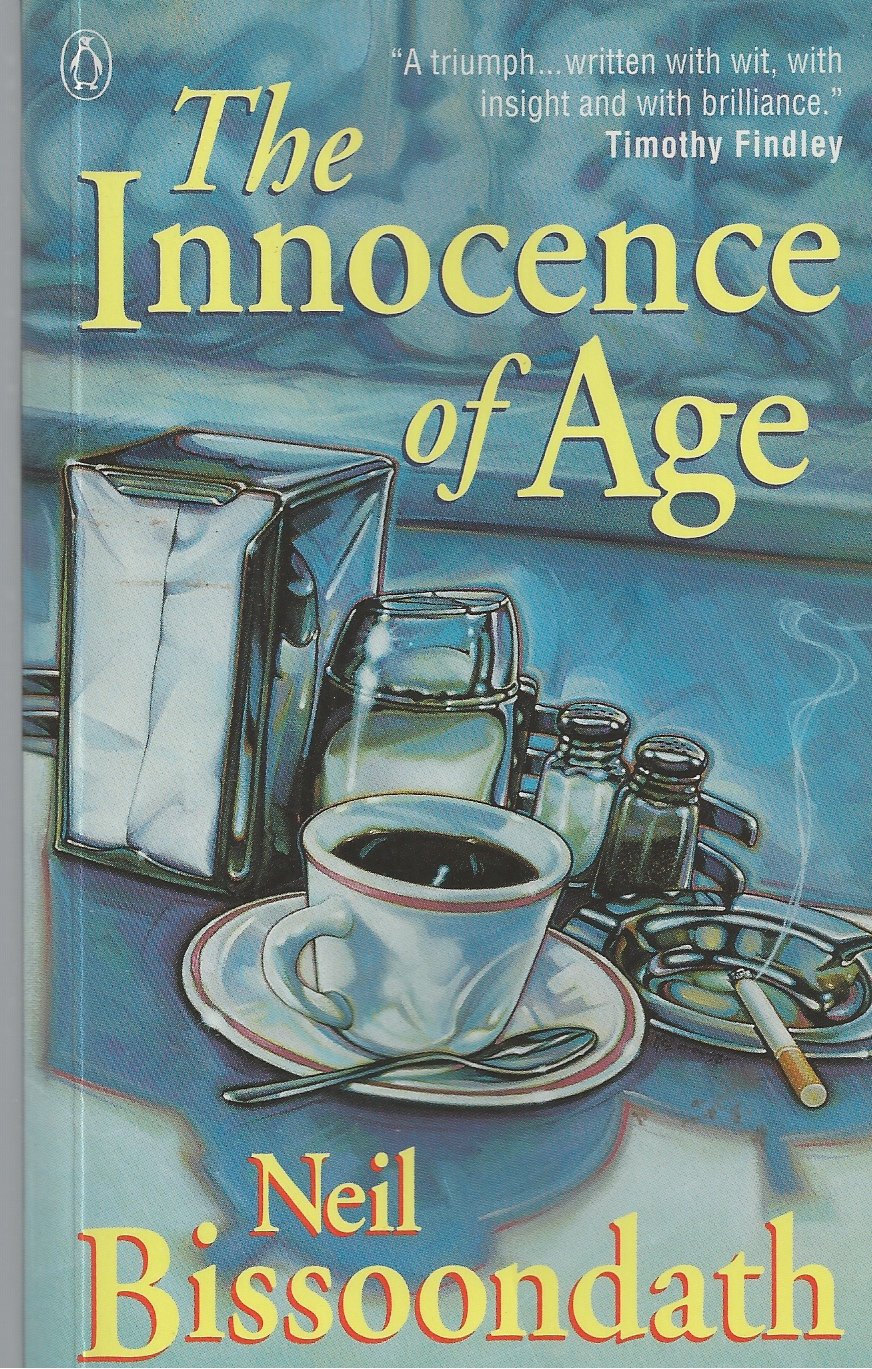
Neil Bissoondath’s The Innocence of Age is a fin de siècle novel reflecting on the generational changes in twentieth century Toronto before going into the twenty-first century. The name is a reversal of Edith Wharton’s Age of Innocence, which novelized New York’s changes from the nineteenth to twentieth century, to ring the end of the twentieth century for Toronto that Wharton began for New York’s age. Whereas Wharton’s Age of Innocence is filled with glamourous upper class New Yorkers with balls and mansions, Bissoondath’s The Innocence of Age has a rather modest line of characters. They are in dive bars talking, back alleys having sex, eating at diners, and living in single-family homes going through Toronto’s transition in the nineties to change from being provincial to being more densely urban.
Old Toronto is represented by the character Pasco. He runs a diner on Dundas and has made enough money to buy a house for his son Danny and his wife Edna. The food is not exactly gourmet, but Pasco does enough so that members of the community can find refuge in his business. He’s a simple man who only wants to make enough money to survive. He joins the other men of his generation drinking cold beer in The Starting Gate, where they can commiserate together about the struggle with the next generation. Pasco doesn’t understand Danny’s obsession with money. Montgomery cannot look past his daughter Nutmeg’s rebellious behaviour. Cruise has to own a book store since he cannot read his university students’ essays anymore.
New Toronto is his son Danny who works for Simmons Construction Company, a firm that builds and rents out apartment complexes with a mean and lean ethos. Determined to be better than his father’s class status, Danny works hard for Mr. Simmons, a symbolic figure for the encroaching neoliberal capitalism in Toronto. Carrying his own history of class shame and struggle, Mr. Simmons implores Danny to see everyone through their usefulness and makes Danny work night and day all for a promise of wealth that never seems to come.
Both Pasco and Danny can see each other’s faults, but none can see each other without judgement to have an honest conversation:
“I want a gilt-edged life, Dad.”
“Is that g-u-i-l-t?”
“Let me put it like this, Dad. Being poor is no turn-on.”
“I’m not poor.”
“You’re not rich either. And it sure hasn’t turned you into Mr. Happiness. If I’ve got to be unhappy in this life, I’d rather be comfortable doing it.” (103)
As shown in the conversation, whereas the father Pasco made money for the family’s survival, Danny the son is the new generation who is making money for comfort. Pasco’s old generation could see happiness as separate from money, whereas Danny representing the new generation sees happiness and money making as interconnected spheres, symbolic of a then emerging neoliberal drive.
At the crisis point of the novel, there is a body in distress that Danny and Pasco cannot ignore. They come together in community and involve other people to restore justice quietly and quickly, seeing each other’s humanity in the way. That provides a new sense of hope. Conflicts between new and old generations will go away when they can look past one another as the source of conflict and see another third body in the equation to come together.
There is a critique to be made about why Bissoondath frequently employs female characters as a third body in the novel to triangulate between Pasco and Danny’s binary conflict: the deceased Edna, Lorraine the next-door neighbour, and Sita the undocumented migrant. However, I found that even then, the Bissoondath writes with so much humanity and care for all the characters in the book. He has an ear for Torontonians like Cruise’s rant that represents the Canadian perspective on the abundance of choice in American-style capitalism:
“A friend of mine went to the Big Apple once, and when he came back he couldn’t stop talkin’ about the variety of things on the store shelves. If we have a choice between, I dunno, say, five kinds of mustard here, they have fifteen to choose from down there. You should have heard him, it was unbelievable. He was dazzled. But who the fuck needs fifteen kinds of mustard?” (9)
The frankness in speech and the ordinary topic of mustard are things I recognize in some of the Canadians I’ve brushed past in my life.
The Innocence of Age is an urban pastoral novel where Toronto is seen as a community of interconnected characters with a unique place in society. The book reminds us that we’re all closer than we think we are.
Works Cited
Bissoondath, Neil. The Innocence of Age. A.A. Knopf Canada, 1992.
Monique Attrux
After spending two decades in Hong Kong where she was born and raised, Monique took her passion for literature with her to Toronto, where she became a PhD candidate at York University. She is deeply passionate about exploring how language shapes and reflects ethnic identities in the realm of literature. Her academic journey has been enriched by the generous support of several scholarships: York Entrance Scholarship (2020), the Vivienne Poy Hakka Research Award (2020), the Ontario Graduate Scholarship (2021), the SSHRC Joseph-Armand Bombardier Canadian Graduate Scholarship (2022), the Canada-China Initiatives Fund (2022), and the Clara Thomas Scholarship in Canadian Studies (2023). She is shaped by Evelyn Lau, Roxane Gay, George Orwell, bell hooks, and Audre Lorde. Although she has a bias for clean prose, her reading tastes are eclectic, and she has yet to claim a favourite author. In time, she hopes to dabble in some creative writing of her own, but for now, she will enjoy the sweet escapes of getting lost in other people’s wor(l)ds.